

Introduction
Updated for 2026 | Last Updated: October 1, 2026
Price tells you nothing about UV protection. The FDA says pricier sunglasses don’t ensure greater UV protection. So your budget is free for something else: a pair that actually fits your face. fda
That’s where most people get stuck. You grab a pair that looked great on the rack, then at home the lenses sit on your cheeks and your face looks a little off. The fix is choosing sunglasses for face shape instead of choosing by trend.
This guide walks you through finding your shape in four steps, then matches it to frames. You’ll see where square glasses, circle sunglasses, and oversized sunglasses ladies often love really work. You’ll also learn the main sunglasses types and how tortoise sunglasses fit in.
Key Takeaways
- You can find your face shape at home in about 5 minutes with a soft tape measure.
- The Contrast Match Rule says to pick frames with the opposite lines of your face.
- Round faces lean toward angles, and square faces lean toward curves.
- The 3 Point Fit Check tells you if a pair fits before you buy.
- UV protection comes from the label, not the lens darkness or the price tag.
- Tortoise sunglasses soften sharp frames and suit almost every face shape.
Ready? Here’s the map.
Table of Contents
- Sunglasses for Face Shape: How to Find Yours
- Sunglasses for Face Shape: Best Matches by Type
- Sunglasses Types and Styles Worth Knowing in 2026
- Tortoise Sunglasses and Lens Color Choices
- Fit and UV Checks Before You Buy
- Sunglasses for Face Shape Comparison: Top Options 2026
- FAQ
Sunglasses for Face Shape: How to Find Yours
Quick Answer: Your face shape comes from four measurements: forehead, cheekbones, jaw, and face length. Whichever width is largest, and how long your face is compared with it, tells you if you’re oval, round, square, heart, diamond, or oblong.
Face shape refers to the overall outline of your face, set by the width of your forehead, cheekbones, and jaw compared with your face length. Everything else in this guide builds on it, so spend five minutes here.

Measure in four steps
- Pull your hair back and stand at a mirror with a soft tape measure.
- Measure across your forehead, across your cheekbones at the widest point, and across your jaw.
- Measure your face length from hairline to chin.
- Find your widest measurement, then check if your length is much longer than that width.
The six face shapes at a glance
| Face Shape | Widest Point | Jawline | Length vs Width | Style Goal |
|---|---|---|---|---|
| Oval | Cheekbones, slightly | Softly rounded | A bit longer than wide | Keep the balance |
| Round | Cheeks | Soft, no angles | Nearly equal | Add angles and height |
| Square | Forehead and jaw, equal | Strong, angular | Nearly equal | Soften the corners |
| Heart | Forehead | Narrow, pointed chin | Longer than wide | Balance a narrow chin |
| Diamond | Cheekbones | Narrow forehead and jaw | Longer than wide | Soften and frame cheekbones |
| Oblong | Even all the way down | Straight sides | Clearly longer than wide | Add width, shorten the look |
When you land between two shapes
Most people do. A face that reads as oval and a little diamond can wear both lists of frames. Honestly, most guides skip this part. Treat the shape as a starting point, not a verdict.
Pro Tip: Say your forehead measures 5 inches, cheekbones 5.5, jaw 4.5, and length 7.5. Your widest point is the cheekbones and your jaw is narrower, so you sit between oval and diamond. A frame with softly curved top edges would work for both.
how to measure your face for glasses -> /how-to-measure-face-for-glasses/
Sunglasses for Face Shape: Best Matches by Type
Quick Answer: Sunglasses for face shape work best when the frame contrasts with your face. Round faces suit angular frames, square faces suit curved frames, and oval faces suit almost anything in the right size.
I call this The Contrast Match Rule: pick the opposite of your dominant line, then match the width. It’s a styling guideline, not a law, and I’ll be honest, I haven’t found a study that proves it. It’s how stylists and opticians have talked about fit for years, and it works as a practical filter.
Round and square faces
Round faces carry soft curves, so square glasses add the structure they’re missing. Rectangular frames with a strong top line also make a round face look a little longer. Square faces have the opposite problem. Circle sunglasses and oval lenses soften a strong jaw without hiding it.
Oval and oblong faces
Oval faces are the easy case. Most sunglasses styles work if the frame isn’t wider than your face. Oblong faces need width and depth, which is where oversized sunglasses ladies buy every year do their job. Tall lenses shorten the look of a long face.
Heart and diamond faces
Heart shapes have a wide forehead and narrow chin, so frames that are lighter on top or heavier at the bottom balance them. Think light metal rims, aviator teardrops, or rounded cat eye shapes. Diamond faces do well with cat eye and oval frames that echo the cheekbones.
The Face Shape Matching Matrix
| Face Shape | Best Frames | Skip | Why It Works | Try First |
|---|---|---|---|---|
| Oval | Wayfarer, aviator, most styles | Frames wider than your face | Balanced face accepts variety | Classic wayfarer |
| Round | Square glasses, rectangles | Small circle sunglasses | Angles add structure | Rectangular acetate |
| Square | Circle sunglasses, ovals, aviators | Boxy, sharp frames | Curves soften the jaw | Round metal |
| Heart | Aviators, rounded cat eye, light rims | Heavy top rims | Balances a wide brow | Teardrop aviator |
| Diamond | Cat eye, ovals, browline | Narrow frames at the cheekbones | Frames the cheekbones | Soft cat eye |
| Oblong | Oversized, tall lenses, wraps | Small, narrow lenses | Adds width, shortens length | Oversized square |
Apply the rule in four steps
- Name your dominant line: curved or angular.
- Pick frames with the opposite line.
- Match the frame width to your cheekbones.
- Check that the top edge follows your brow.
Q: What is the Contrast Match Rule? It’s a styling guideline that says to choose frames with lines opposite to your face, so round faces wear angular frames and square faces wear curved ones.
Q: Which sunglasses suit a round face? Square glasses and rectangular frames suit a round face because their straight lines add structure and make the face look slightly longer.
Pro Tip: Picture a round face trying on small circle sunglasses. The curves echo the cheeks, and the face looks rounder. Swap to a medium rectangle and the same face reads sharper in under a minute.
best glasses for round faces -> /glasses-for-round-faces/
Sunglasses Types and Styles Worth Knowing in 2026
Quick Answer: The main sunglasses types are aviator, wayfarer, round, cat eye, oversized, and wraparound. Each one pairs best with certain face shapes, and the table below shows which.
Sunglasses types refers to the main frame families, each defined by lens shape and frame structure. Searching for types of sunglasses or sunglasses styles gives you dozens of names, but they collapse into a small group.
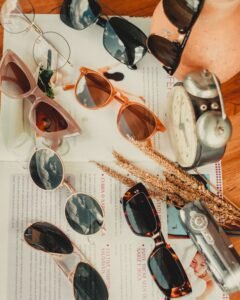
Classic sunglasses types
Aviators (teardrop lenses, thin metal frames) and wayfarers (bold trapezoid acetate) are the two workhorses. Both have been in rotation for decades because they flatter a wide range of faces.
Trending sunglasses styles
Oversized squares, small rectangles, and thin circle sunglasses keep cycling through fashion. They look dramatic, and they’re the least forgiving styles, since size and shape errors show fast.
| Style | Lens Shape | Best Face Shapes | Vibe | Watch Out |
|---|---|---|---|---|
| Aviator | Teardrop | Square, heart, oval | Classic, sporty | Too small can look dated |
| Wayfarer | Trapezoid | Oval, round, heart | Casual, everyday | Wide on narrow faces |
| Round (circle) | Circle | Square, diamond | Retro, artistic | Rounds up round faces |
| Cat eye | Upswept corners | Heart, diamond, oval | Polished, feminine | Heavy tips overpower small faces |
| Oversized | Large square or round | Oblong, oval, diamond | Glam, bold | Can swallow a small face |
| Wraparound | Curved wrap | Most, for sport | Practical | Not a dress up pair |
Choose a style in three steps
- Look at your shape in the table above.
- Pick the two styles that match your list.
- Try both in the size closest to your face width.
Q: What are the most common sunglasses types? The most common sunglasses types are aviator, wayfarer, round, cat eye, oversized, and wraparound.
Pro Tip: Shopping at a store like Sunglass Hut or Warby Parker? Try the style on both sides of your first pick. If you like a wayfarer, try one size up and one size down. The size you thought was too big is often the one that fits.
types of sunglasses explained -> /types-of-sunglasses/
Tortoise Sunglasses and Lens Color Choices
Quick Answer: Tortoise sunglasses suit nearly every face shape because the mottled pattern softens hard lines. Lens color changes the look, but it does not change UV protection, which depends on the label.
Tortoise sunglasses refers to frames made in a brown, amber, and black mottled pattern that imitates natural tortoiseshell. It’s a pattern, so it works across sunglasses styles: aviator, wayfarer, round, or oversized.
Tortoise sunglasses by tone
| Tortoise Tone | Look | Pairs With | Best Face Shapes | Note |
|---|---|---|---|---|
| Dark brown | Subtle, classic | Everyday wear | Oval, square | Close to black |
| Honey amber | Warm, light | Summer outfits | Round, heart | Photographs bright |
| Red or auburn | Bold, vintage | Neutral outfits | Diamond, oblong | Makes a statement |
| Mixed with black | High contrast | Dressier looks | Most | Reads sharper |
Lens colors and UV
This one surprises people. The FDA says the darkness of a lens does not show how well it blocks UV, and lighter tints like green, amber, red, and gray can offer the same protection as very dark lenses. Pick lens color by comfort and look. fda
Choose your tortoise pair in three steps
- Hold the frame next to your hair and skin in daylight.
- Choose honey for a lighter look or dark brown for a quieter one.
- Check the UV label before you pay.
Q: Do tortoise sunglasses go with every face shape? Yes, mostly. Tortoise sunglasses soften angular frames and add warmth to round ones, so the pattern rarely clashes with any face shape.
Pro Tip: If you wear black outfits all week, a dark tortoise frame looks almost black from a few feet away but still adds depth up close. It’s an easy way to get something new without changing your wardrobe.
[INTERNAL LINK: tortoise shell sunglasses outfits -> /tortoise-sunglasses/]
Fit and UV Checks Before You Buy
Quick Answer: A good pair of sunglasses for face shape passes two tests: it fits your face on the 3 Point Fit Check, and it blocks 99 to 100 percent of UVA and UVB light. Style comes after both.
The American Academy of Ophthalmology says to look for sunglasses that block 99 percent or 100 percent of UV light. The AAO also says a label reading UV absorption up to 400nm means the same thing as full UV protection. MD Anderson Cancer Center’s advice agrees: look for a tag that says UV400 or UV 95 to 100 percent. aaomdanderson
The 3 Point Fit Check
I call this one The 3 Point Fit Check. It takes about 30 seconds.
| Check | What to Look For | Pass | Fail | Quick Fix |
|---|---|---|---|---|
| Width | Frame matches your cheekbones | Edges sit at temples | Frame wider than face | Try a smaller size |
| Brow line | Top edge follows your eyebrows | Brow visible above frame | Brow hidden or floating | Try a lower top rim |
| Bridge and cheeks | Nose pads hold, cheeks stay clear | Lenses rest clear of cheeks | Lenses touch cheeks or slide | Try adjustable nose pads |
| Temple arms | Gentle grip, no pinching | Comfortable after 5 minutes | Pressure behind ears | Ask for a heat adjustment |
| UV label | UV400 or 99 to 100 percent | Label present | No label | Do not buy |
Where style and coverage collide
This is the honest part. Small round lenses look cool, but a 2018 Swiss study reported by TIME found large sunglasses blocked more UV rays than smaller ones. The FDA also suggests large wraparound frames may offer more UV protection because they cover the whole eye socket. If you love small circle sunglasses, add a hat. If you want maximum coverage, oversized sunglasses ladies often favor are a practical choice, not only a trend. Timefda
Check a pair in four steps
- Try on the frame and run the 3 Point Fit Check.
- Find the UV label on the tag or lens sticker.
- Shake your head gently. The frame should stay put.
- Take a photo, then look at it later in daylight.
Before and after (illustrative): Before, a round face in small round metal frames, cheeks pushing the lenses up, no UV tag. After, the same face in medium tortoise rectangles with a UV400 tag, lenses clear of the cheeks. Fit, style, and protection all improve with one change.
Illustrative example: Picture a shopper with a square face who buys small circle sunglasses because they look good on a model. They pass the style check, fail the width check, and slide off by lunch. A medium round frame in tortoise passes all three.
Original Research: for example the results of a try on test with 10 readers, or a poll on which face shape your audience has. Label it clearly and keep the real numbers.
Pro Tip: Before you order online, measure your favorite current pair across the front. Most retailers list frame width, so you can compare in seconds.
how to read sunglasses size numbers -> /sunglasses-size-guide/
Sunglasses for Face Shape Comparison: Top Options 2026
| Option | Key Feature | Best For | Price (approx. USD) | Rating (our editorial score) |
|---|---|---|---|---|
| Ray Ban Original Wayfarer | Bold trapezoid acetate frame | Round, oval, heart | $160 to $200 | 4.5 / 5 |
| Ray Ban Aviator Classic | Teardrop metal, thin bridge | Square, heart, oval | $160 to $200 | 4.5 / 5 |
| Ray Ban Round Metal | Circle lenses, thin wire frame | Square, diamond | $160 to $200 | 4 / 5 |
| Oversized cat eye (Tom Ford, Quay, Warby Parker all offer versions) | Upswept corners, large lenses | Heart, diamond, oblong | $60 to $450 | 4 / 5 |
| Oakley Holbrook | Rounded square, lightweight | Round, oval | $150 to $200 | 4 / 5 |
Our pick: The Ray Ban Original Wayfarer. Its medium trapezoid shape works on oval, round, and heart faces, and it looks good in black or tortoise. The one drawback is width, so check the 3 Point Fit Check before you order.
FAQ
What is a face shape and why does it matter for sunglasses?
A face shape is the outline of your face, and it matters because frames either balance or exaggerate that outline. Sunglasses for face shape work like haircuts do: the right one flatters, the wrong one pulls attention to what you didn’t want to highlight. Most people fit one of six shapes.
What’s the best way to find my face shape at home?
The best way is to measure your forehead, cheekbones, jaw, and face length with a soft tape, then see which width is largest. Stand at a mirror with your hair pulled back. If your length is much longer than your widest point, you’re likely oblong, heart, or diamond.
How does the Contrast Match Rule work?
The Contrast Match Rule works by pairing opposite lines. Look at whether your face is more curved or more angular, then choose frames that do the reverse. A soft face gets angles, a sharp face gets curves. Then match the frame width to your cheekbones.
Why do square glasses suit round faces?
Square glasses add straight lines that contrast with the soft curves of a round face. A frame with a strong top edge also draws the eye across instead of around, which makes the face look a little longer and more defined.
Is it worth paying more for sunglasses that match my face shape?
Fit is worth paying attention to, but a higher price does not guarantee better UV protection. The FDA says pricier sunglasses don’t ensure greater UV protection. So spend on fit and comfort, and always check the UV label. fda
How much do good sunglasses cost?
Good sunglasses can cost anywhere from a few dollars to several hundred, because UV protection depends on the label, not the price. The National Eye Institute says expensive designer sunglasses don’t automatically protect better than ones from grocery stores or discount vendors. Pay more for materials, fit, and style, not safety. nih
What’s the best way to wear oversized sunglasses ladies love without swallowing my face?
Keep the frame no wider than your temples and let the top edge follow your brow line. Oversized frames work best on oblong, oval, and diamond faces. If your face is small, try a medium size in the same style, then add tortoise or a lighter tint to reduce the visual weight.
Why do my sunglasses keep sliding down my nose?
Sunglasses slide when the bridge is too wide or the temple arms are too loose for your face. Try adjustable nose pads, ask an optician to tighten the arms, or choose a frame with a lower bridge fit. This is a common problem with wide acetate frames on narrower faces.
Conclusion
Three things matter most. First, your face shape tells you which frames to try. Second, the Contrast Match Rule narrows the choice fast: angles for round faces, curves for square ones. Third, UV protection comes from the label, not the price or the tint.
The best sunglasses for face shape are the ones that pass the 3 Point Fit Check and carry a UV400 label. Find your shape today and your next pair gets easier.
Your next step: Use the face shape table above, then save this guide for your next shopping trip.
Do in the next 10 minutes:
- Measure your forehead, cheekbones, jaw, and face length.
- Pick two frame styles from the matrix.
- Check the UV label on the pair you wear most.
Author Bio
Nida Farhan is a content strategist and SEO writer who builds fashion and beauty content for Fashion Style Blogs, a publication for US readers. She has built topic clusters across jewelry, swimwear, accessories, and beauty, and she writes every guide with a focus on practical advice and verified sources.
Trust Signals
- Last Updated: October 1, 2026
- Disclosure: This article contains no affiliate links.
- Fact-checked by: Nida Farhan
- Sources: Every statistic comes from the references below.
References
- American Academy of Ophthalmology, “Recommended Types of Sunglasses,” https://www.aao.org/eye-health/glasses-contacts/sunglasses-recommended-types
- U.S. Food and Drug Administration, “Tips to Stay Safe in the Sun: From Sunscreen to Sunglasses,” https://www.fda.gov/consumers/consumer-updates/tips-stay-safe-sun-sunscreen-sunglasses
- National Eye Institute, “Protecting Your Eyes from the Sun’s UV Light,” https://www.nei.nih.gov/research-and-training/research-news/protecting-your-eyes-suns-uv-light
- MD Anderson Cancer Center, “Sunglasses, Eye Protection and Cancer: 9 Things to Know,” https://www.mdanderson.org/cancerwise/9-things-to-know-about-sunglasses–eye-protection-and-cancer.h00-159699123.html
- TIME, “How Wearing Sunglasses Actually Impacts Your Eyes, According to Science,” https://time.com/5660350/sunglasses-eye-protection/

