

Introduction
More than 7 in 10 American adults say they wear sunglasses when the sun feels too bright, and over 60 percent say they wear them to block UV rays (The Vision Council, 2023). So why do so many of us still buy a pair in thirty seconds at a checkout counter? invisionmag
Here’s the honest problem. Shoppers pick sunglasses by looks, then assume the protection comes free. Sometimes it does. Sometimes the pair on your face is just dark plastic. And the market doesn’t help, with hundreds of sunglasses styles, a dozen lens options and a brand name on every arm.
This guide fixes that. You’ll learn the main types of sunglasses, how to match frames to your face, which sunglasses brand fits your budget, and how to check UV protection in under a minute. I wrote it for US readers, so prices are in dollars and the rules follow FDA and ANSI standards.
Key Takeaways
- UV400 or “100 percent UVA/UVB” on the label is the one protection check that matters, and it works at any price.
- Polarized and dark lenses cut glare and brightness. They don’t add UV protection.
- Square glasses soften round faces, and circle sunglasses soften angular ones. That’s the Contrast Rule.
- More than 54 percent of Americans have light colored eyes, which raises UV risk.
- Three pairs cover most lives: one daily, one statement, one active. That’s the Rule of Three.
Ready? Here’s where everything sits.
Table of Contents
- What Are Sunglasses and How Do They Work?
- Sunglasses Styles in 2026: Shapes That Rule
- Types of Sunglasses by Lens and Activity
- How to Choose Sunglasses for Your Face Shape
- Top Sunglasses Brands for US Shoppers in 2026
- Sunglasses Safety: UV400, FDA and Fake Labels
- Sunglasses Comparison: Top Options at a Glance
- FAQ
What Are Sunglasses and How Do They Work?
Quick Answer: Sunglasses are eyewear that reduces bright light and blocks ultraviolet rays before they reach your eyes. The label that matters most says 100 percent UVA/UVB or UV400. Tint color, polarization and brand name don’t change that.
Sunglasses are defined as tinted or coated eyewear that reduces glare and filters ultraviolet radiation to protect the eyes and the skin around them. That’s the whole job. Style is a bonus, and honestly a big one, but protection comes first.

Why UV Protection Comes First
The American Academy of Ophthalmology (AAO) says long term sun exposure without protection raises the risk of cataracts, growths on the eye and eye cancer (AAO, accessed 2026). The same AAO guidance says to choose sunglasses that block 99 to 100 percent of both UVA and UVB radiation. aao
UV400 refers to lenses that block light wavelengths up to 400 nanometers, which covers all UVA and UVB rays. All About Vision notes that UV400 lenses give nearly complete protection, and that UV damage builds up over a lifetime (All About Vision, 2019). allaboutvision
Short exposure can hurt too. Sun bouncing off water can cause a painful sunburn on the front of the eye called photokeratitis, with redness, blurry vision and light sensitivity (AAO, accessed 2026). Think of a beach day where your eyes feel like sandpaper that night. That’s the same thing. aao
Tint, Polarization and Glare
A dark tint feels protective, but it’s a comfort feature. The AAO states that darker lenses and polarized lenses do not block more radiation (AAO, accessed 2026). Worse, health reporting from TODAY, cited by LasikMD, warns that dark lenses without UV protection can be worse than no sunglasses. The dark tint makes pupils widen, so more UV can enter the eye (TODAY via LasikMD, accessed 2026). newswiselasikmd
Polarized lenses are defined as lenses with a filter that blocks reflected glare from flat surfaces like water, roads and car hoods. The AAO explains they cut glare rather than block UV, so you still need a UV label (AAO via LasikMD, accessed 2026). lasikmd
Q: Do darker sunglasses protect your eyes better?
A: No. Lens darkness controls how bright the world looks, not how much UV gets through. Only the UV rating tells you about protection, so a pale lens with UV400 beats a black lens with no label.
The Label, Lens, Look Method
This is the first of our original frameworks. The Label, Lens, Look Method is a three layer check for any pair of sunglasses, in this order.
- Label: Does it say UV400 or 100 percent UVA/UVB? If not, stop.
- Lens: Is the tint, polarization and material right for how you’ll use them?
- Look: Does the frame fit your face and your wardrobe?
Most people start at layer three and never reach layer one. Flip that order and you’ll rarely regret a purchase.
| Lens Feature | What It Does | Blocks UV by Itself? | Best For | Watch Out For |
|---|---|---|---|---|
| UV400 coating or material | Blocks wavelengths up to 400 nm | Yes | Every pair | Missing label on cheap pairs |
| Polarized filter | Cuts reflected glare | No | Driving, water, snow | Can make some screens harder to read |
| Dark tint | Reduces brightness | No | Very sunny days | False sense of safety |
| Mirrored coating | Reflects extra light | No | Bright, open spaces | Scratches show easily |
| Photochromic lens | Darkens in sunlight | Varies by product | Changing light | Slower in hot weather or in cars |
| Gradient tint | Darker on top, lighter below | No | Driving, casual wear | Less coverage for bright reflections |
Table: sunglasses lens features compared by UV protection and best use.
How to read a sunglasses label in four steps:
- Look for a sticker on the lens or a tag on the temple.
- Find “UV400” or “100% UVA/UVB.”
- Check whether the line says “polarized” too.
- If you see nothing, leave the pair in the store or test it at an optical shop.
Pro Tip: Keep the sticker from your favorite pair in a photo album on your phone. When it’s time to replace them, you’ll know the exact lens spec that worked, instead of guessing from memory.
summer sun protection guide -> /sun-protection-beauty-guide/
UV400 sunglasses block light wavelengths up to 400 nanometers, which covers all UVA and UVB rays.
Sunglasses Styles in 2026: Shapes That Rule
Quick Answer: The most popular sunglasses styles are aviator, square, circle, cat eye, oversized, rectangle and wraparound. Square glasses and oversized frames lead everyday fashion, while wraparounds win for coverage. Pick a style that suits your face and how you dress most days.
Sunglasses styles refers to the frame shapes and design details that define how a pair looks, separate from the lens technology inside. The same UV400 lens can sit in a dozen different frames.
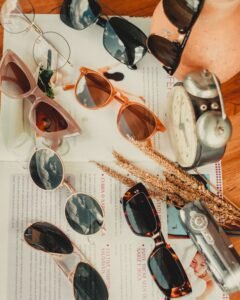
Square Glasses and Sharp Frames
Square glasses are frames with straight top lines and angled corners. Think classic Wayfarer shapes like the Ray-Ban Original Wayfarer. They add structure, which is why they flatter rounder faces so well.
Square frames also photograph well and pair with almost everything from denim to blazers. My mild opinion? If you’re buying only one pair this year, start here.
Circle Sunglasses and Round Frames
Circle sunglasses are round frames with soft edges, often thin metal, that give a retro, artistic look. They contrast beautifully with angular jawlines. On a round face they can look like two extra circles, so check the fit before you commit.
Oversized Sunglasses for Ladies
Oversized sunglasses ladies shop for are large frames that cover much of the upper face. They bring glamour, and they bring practical cover too. The AAO says sunglasses with larger lenses may offer more protection, and wraparound designs give the best coverage against side light (AAO, accessed 2026). newswise
Q: Do oversized sunglasses protect eyes better than small frames?
A: They can, because larger lenses block more light leaking in from the sides and top. Coverage still depends on the UV label, so an oversized pair without UV400 is only a big dark frame.
Here’s a small beauty note. If you wear lash extensions, choose frames with deeper lens curves so longer lashes don’t brush the glass.
Aviators, Cat Eyes and Rectangles
Aviators use a teardrop shape and thin metal rims. Cat eye frames sweep upward at the outer corners and lift the face. Rectangle frames are slimmer and more minimal, and they suit office style outfits.
Our Data: Editorial Style Scores
Our Data: When I built this table, I scored every style against the same four questions so the numbers stay consistent. These are editorial judgments on a 1 to 5 scale, not lab tests or customer reviews.
| Style | Shape Cue | Best For | Everyday Wear | Statement Value | Coverage |
|---|---|---|---|---|---|
| Square | Straight lines, angled corners | Round and oval faces | 5 | 3 | 4 |
| Aviator | Teardrop, thin metal | Oval and square faces | 4 | 4 | 3 |
| Circle | Round, thin rims | Square and diamond faces | 3 | 4 | 3 |
| Cat eye | Upswept outer corners | Heart and oval faces | 3 | 5 | 3 |
| Oversized | Large, tall lenses | Long and narrow faces | 3 | 5 | 5 |
| Rectangle | Slim and flat | Round and oval faces | 4 | 3 | 3 |
| Wraparound | Curved, close to face | Active outdoor use | 2 | 2 | 5 |
Table: sunglasses styles scored for everyday wear, statement value and coverage.
How to build a sunglasses style shortlist in four steps:
- Save five photos of sunglasses you liked on other people.
- Circle the shape they share (square, round, angled).
- Check that shape against your face shape in the next section.
- Try three pairs in that shape before you buy one.
Pro Tip: Try sunglasses in daylight near a shop window. Store lighting flatters everything, and a frame that looked sharp under spotlights can look heavy outside.
summer outfit ideas -> /summer-outfit-ideas/
Types of Sunglasses by Lens and Activity
Quick Answer: The main types of sunglasses are polarized, photochromic, mirrored, gradient, light tint, sport wraparound and prescription sunglasses. Match the type to what you do most: driving, water, sport or city walking. UV400 is required in every type.
Types of sunglasses refers to categories based on lens technology and intended use, such as polarized, photochromic and sport. Style is about frame shape. Type is about what the lens does.

Polarized and Photochromic Lenses
Polarized sunglasses shine on the water, in snow and behind a windshield. Polarized lenses hold the largest product type share of the global market at 42.3 percent (Grand View Research, 2025). ringly
Photochromic lenses are defined as lenses that darken automatically when exposed to UV light and lighten indoors. They work well if you move between shade and sun all day. Well, more precisely, they work well outdoors. Many cars filter UV, so they may stay lighter behind the wheel.
Light Sunglasses: Tint or Weight?
Light sunglasses can mean two things, and shoppers search both. One is a lightweight frame that feels easy on your nose all day. The other is a light tint lens that stays comfortable in low sun or on cloudy days.
Either way, UV400 still applies. Harmful UV rays are present even on cloudy days, according to the AAO (AAO, accessed 2026). A pale lens with UV protection is safer than a dark one without it. newswise
Sport and Wraparound Sunglasses
Wraparound sunglasses are frames that curve around the face to block side light and wind. The AAO says wraparounds also help protect eyes from wind, dry eye and grit (AAO, accessed 2026). Polycarbonate lenses are reported to be 10 to 20 times more impact resistant than glass or standard plastic, and they naturally block UV up to 400 nm (Police and Security News, 2020). newswisepoliceandsecuritynews
The tradeoff? Wraparounds look sporty, and not everyone wants that in a city outfit.
Lens Colors and What They Do
Gray and green lenses are good everyday choices because they cut glare without dulling colors, while red lenses can improve depth perception and yellow lenses can help in hazy light (All About Vision, cited by iMatrix, accessed 2026). Brown and amber work well for contrast in golf and driving. imatrix
| Type | Lens Technology | Best For | Typical US Price | Main Limitation |
|---|---|---|---|---|
| Polarized | Glare filter | Driving, fishing, snow | $30 to $250 | Some screens look dim |
| Photochromic | Light reactive lens | Mixed indoor and outdoor days | $80 to $300 | Slow in cars and heat |
| Mirrored | Reflective coating | Bright beaches, mountains | $25 to $200 | Scratches show easily |
| Gradient | Two tone tint | Casual wear and driving | $20 to $150 | Less protection from low glare |
| Light tint | Pale lens | Cloudy days, indoor style | $20 to $150 | Not for intense glare |
| Sport wraparound | Curved polycarbonate | Running, cycling, golf | $50 to $250 | Bold look |
| Prescription | Lens made to your Rx | Daily wear if you need vision correction | $150 to $500 | Higher cost |
Table: types of sunglasses compared by technology, use, price and limitation. Prices are typical US ranges and change often.
How to choose a sunglasses type by activity in four steps:
- Write down the three places you wear sunglasses most.
- If one is near water or driving, add polarized.
- If you spend time outdoors on the move, add wraparound or sport.
- Pick the lens color from the list above and confirm UV400.
Pro Tip: A cyclist I’d imagine on a morning commute needs wraparound polycarbonate with clear side coverage. A weekend brunch crowd needs a pair that looks great and blocks UV. Same rule, different frames.
Q: Are polarized sunglasses better for driving?
A: Often, yes, because they cut reflected glare from roads and other cars. Some drivers find them harder to use with certain dashboard screens, so test them in your car before you commit.
beach day essentials -> /beach-day-essentials/
How to Choose Sunglasses for Your Face Shape
Quick Answer: Choose sunglasses that contrast with your face shape. Round faces suit square glasses, angular faces suit circle sunglasses, and long faces suit oversized frames. Fit matters as much as shape.
Face shape refers to the overall outline of your face, usually described as oval, round, square, heart, diamond or oblong. Sunglasses styles work best when they balance those lines instead of copying them.
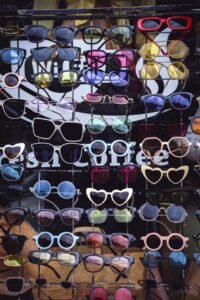
Find Your Face Shape at Home
How to find your face shape in four steps:
- Pull your hair back and stand in front of a mirror.
- Note the widest point: forehead, cheekbones or jaw.
- Compare face length to width.
- Match the outline to the closest shape in the table below.
Don’t overthink it. Most faces sit between two shapes, and that’s fine.
The Contrast Rule
The Contrast Rule is our second original framework: choose a frame whose lines oppose your strongest facial lines. Angles balance curves, and curves soften angles.
It’s a guide, not a law. If you love a shape that breaks the rule, wear it.
| Face Shape | Frame Cue | Styles to Try | Styles to Skip | Why It Works |
|---|---|---|---|---|
| Oval | Balanced proportions | Aviator, square, cat eye | Frames much wider than the face | Face is already balanced |
| Round | Angular lines | Square glasses, rectangle | Small circle sunglasses | Sharp lines add structure |
| Square | Soft curves | Circle sunglasses, aviator | Heavy boxy frames | Curves soften the jaw |
| Heart | Light lower rims | Aviator, round, light cat eye | Heavy top bars | Balances a wide forehead |
| Diamond | Upswept lines | Cat eye, oval | Narrow rimless frames | Highlights cheekbones |
| Oblong | Deeper, wider frames | Oversized, round | Small narrow frames | Adds width to a long face |
Table: face shapes matched to sunglasses styles using the Contrast Rule.
Fit Details That Matter
Fit isn’t just comfort, it’s protection. If the temples squeeze or the nose pads pinch, you probably won’t wear the pair as often as you should (iMatrix, citing AAO guidance, accessed 2026). A pair sitting in a drawer protects nobody. imatrix
Check three things. The frame should sit close enough to block side light, the nose pads shouldn’t slide, and your lashes shouldn’t touch the lens.
Example: Before and After (illustrative scenario, not a real client). Maya, 34, has a round face. She bought $18 circle sunglasses because they looked great online. There was no UV label, and the frames made her face look rounder. After using the Label, Lens, Look Method, she returned them and bought a square pair for about $65 with a clear “100% UVA/UVB” label. The result: better protection, a sharper look, and a pair she wore all summer.
Q: What sunglasses suit a round face?
A: Square glasses and rectangle frames suit round faces, because straight lines add structure. Avoid tiny circle sunglasses, which repeat the round shape and can make the face look fuller.
Pro Tip: Take a photo in each pair from the front and the side. Photos show what mirrors hide, like frames sliding down or covering too much of your cheeks.
face shape makeup guide -> /face-shape-makeup-guide/
Top Sunglasses Brands for US Shoppers in 2026
Quick Answer: Popular US sunglasses brands include Ray-Ban, Oakley, Persol, Costa Del Mar, Maui Jim, Warby Parker and Quay. Brand affects design, lens quality and warranty, but not the basic UV requirement. Pick by use and budget, then check the label.
A sunglasses brand is defined as a company that designs, makes or licenses sunglasses under its own name. Names can signal quality, but they don’t replace a label check. The AAO says a higher price tag does not guarantee UV protection, and inexpensive sunglasses with a 100 percent UV label can protect as well as name brands (AAO, accessed 2026). newswise
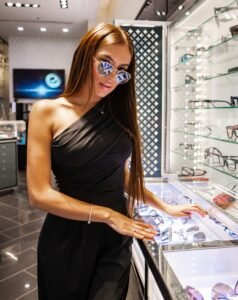
Everyday Sunglasses Brands
Ray-Ban and Persol lead classic style. Ray-Ban is known for Wayfarer and Aviator shapes. Persol leans Italian, with handmade looks and folding options.
Warby Parker is a strong choice if you like simple acetate frames and a try at home style of shopping. Quay works when you want fast fashion looks at lower prices.
Performance and Outdoor Brands
Oakley builds for sport, with lightweight frames and strong lens tech. Costa Del Mar focuses on fishing and water, with polarized lenses made for glare. Maui Jim is known for polarized lenses and color enhancing tints.
Ray-Ban and Oakley are both made by EssilorLuxottica, a company that controls roughly a quarter of the global eyewear market (Fortune via Ringly, 2026). That helps explain why you see them everywhere. ringly
How Big Is the Market?
According to The Vision Council, the US optical industry grew 2.7 percent in 2024 to reach $68.3 billion, and more than 240 million US adults use some kind of eyewear (The Vision Council, 2024). Globally, sunglasses were valued at about $43.03 billion in 2025, with a projected 10.1 percent annual growth rate through 2033 (Grand View Research, 2025). ewintelligenceringly
Care, Cost and When to Replace
Clean lenses with a microfiber cloth and lens cleaner. A shirt hem scratches coatings. Store them in a case, not a hot dashboard.
Replace sunglasses when lenses are deeply scratched, coatings peel, or the frame no longer holds its shape. Cost isn’t the only factor. A $150 pair used for five summers beats a $20 pair replaced every season.
| Brand | Known For | Price Tier (Typical US) | Best For | Where to Shop |
|---|---|---|---|---|
| Ray-Ban | Classic Wayfarer and Aviator shapes | to $ | First or daily pair | Brand site, Sunglass Hut, department stores |
| Oakley | Sport lens tech, light frames | to $ | Active days | Brand site, sports retailers |
| Persol | Italian design, folding frames | $$$ | Style focused shoppers | Sunglass Hut, opticians |
| Costa Del Mar | Polarized lenses for water | $$$ | Fishing, boating | Brand site, outdoor retailers |
| Maui Jim | Color enhancing polarized lenses | $$$ | Bright, sunny locations | Brand site, opticians |
| Warby Parker | Simple acetate frames | $$ | Everyday, online shopping | Warbyparker.com and stores |
| Quay | Trend led fashion styles | $ to $$ | Budget statement pairs | Brand site, department stores |
Table: popular sunglasses brands compared by focus, price and where to shop. $ is under $80, $$ is $80 to $200, and $$$ is above $200.
The Rule of Three is our third original framework: own one everyday pair, one statement pair and one active pair. Everyday covers commuting and errands, statement covers events and vacations, and active covers driving, running or sport. Three pairs remove the pressure to find one perfect frame.
The five minute store test, in five steps:
- Look for UV400 or 100 percent UVA/UVB on the tag.
- Try the pair on and shake your head gently. It shouldn’t slip.
- Look at a straight line, like a door frame, through the lens. It shouldn’t bend or wave.
- Check side coverage and lash clearance in a mirror.
- Take a photo and ask yourself if you’d wear it three times this week.
Pro Tip: Buy your active pair first if you drive or exercise outdoors, since safety gains matter most there. Then add style pairs as your budget allows.
fashion accessories guide -> /fashion-accessories-guide/
Sunglasses Safety: UV400, FDA and Fake Labels
Quick Answer: Safe sunglasses carry a UV400 or 100 percent UVA/UVB label and meet US safety rules. The FDA treats nonprescription sunglasses as medical devices, and ANSI Z80.3 covers UV and impact standards. Price and brand aren’t proof.
UV protection labels are defined as manufacturer statements telling you how much ultraviolet light the lenses block. Some are precise, some are vague. Learning the difference takes about a minute.
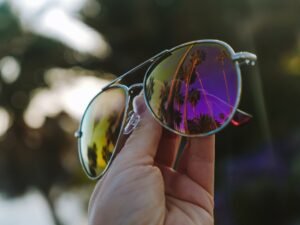
What UV400 Really Means
UV400 tells you the lens blocks wavelengths up to 400 nanometers. The AAO says a label reading 100 percent UVA/UVB and one reading UV400 both mean full protection (AAO, accessed 2026). Either label works. aao
FDA and ANSI Rules in the US
The FDA regulates nonprescription sunglasses sold in the US as Class 1 medical devices, and compliance with the voluntary ANSI Z80.3 standard is considered acceptable (FDA and ANSI, via Diaz Trade Law and Spotter Up, accessed 2026). Lenses must also be certified as impact resistant under 21 CFR 801.410 (Diaz Trade Law, 2019). americancopdiaztradelaw
Blue light, or HEV, blocking isn’t required by the FDA, even though some sunglasses offer it (Spotter Up, accessed 2026). So a “blue light” claim on the tag is a bonus, not proof of UV safety. spotterup
Sunglasses for Kids and Light Eyes
Children can be at higher risk because the lenses inside their eyes are more transparent, so UV rays can travel deeper (All About Vision, 2019). Adults with blue, green or hazel eyes may also face higher UV risk, and more than 54 percent of Americans have light colored eyes (AAO via iMatrix, accessed 2026). allaboutvisionimatrix
Sunglasses are also just one layer. The Vision Council found adults were less likely to wear sunscreen (56 percent) or hats (55 percent) than sunglasses (70 percent) (The Vision Council, 2023). A wide brim hat plus sunglasses gives extra coverage. invisionmag
| Label Claim | What It Means | Trust Level | What to Do |
|---|---|---|---|
| UV400 | Blocks up to 400 nm | High | Buy with confidence |
| 100% UVA/UVB | Blocks all UV rays | High | Buy with confidence |
| “UV protection” only | No number given | Low | Ask for specs or test |
| Polarized only | Glare filter | None for UV | Look for a UV label too |
| Dark tint only | Reduces brightness | None for UV | Skip without a label |
| Blocks blue light | Filters HEV light | Not FDA required | Treat as a bonus |
| ANSI Z80.3 compliant | Meets US sunglasses standard | Medium to high | Confirm UV rating too |
Table: how to read common sunglasses label claims.
How to verify sunglasses UV protection in four steps:
- Read the label for UV400 or 100 percent UVA/UVB.
- Check the brand’s website for the exact lens spec.
- If you’re unsure, visit an optical shop for a photometer test.
- Skip any pair with no label from an unknown seller.
Pro Tip: If you doubt a label, optical shops and ophthalmologist offices can test the lenses with a photometer (AAO via Newswise, accessed 2026). It takes a few minutes and often costs nothing. newswise
Q: Are expensive sunglasses safer than cheap ones?
A: Not necessarily. UV protection depends on the lens spec, not the price. Higher prices usually buy better optics, frames and durability, so pay more for those, not for safety.
A fair tradeoff worth naming: no single pair does everything. Polarized lenses can dim some screens, wraparounds can look sporty, and premium pairs cost more to replace when lost. Choose the compromise you can live with.
eye care and beauty tips -> /eye-care-beauty-tips/
Sunglasses Comparison: Top Options at a Glance
Here’s the Sunglasses Comparison: Top Options at a Glance. Ratings are editorial scores out of 5 based on the Label, Lens, Look Method, not customer review averages, and prices are approximate US ranges that change often. Confirm the UV label on the exact pair you buy.
| Option | Key Feature | Best For | Price (Approx. US) | Rating (Editorial) |
|---|---|---|---|---|
| Ray-Ban Original Wayfarer Classic | Square acetate frame | First pair for most face shapes | $160 to $200 | 4.6 |
| Ray-Ban Aviator Classic | Metal teardrop frame | Oval and square faces | $160 to $200 | 4.4 |
| Oakley Holbrook | Lightweight frame, sport lens tech | Daily wear plus active use | $150 to $200 | 4.3 |
| Costa Del Mar Fantail | Polarized lenses for water glare | Fishing and boating | $180 to $260 | 4.2 |
| Persol 649 | Italian design, refined shape | Style focused shoppers | $300 to $400 | 4.1 |
| Quay High Key | Trend led fashion frame | Budget statement pair | $55 to $80 | 3.9 |
Table: top sunglasses options compared by key feature, best use, price and editorial rating.
Our pick: The Ray-Ban Original Wayfarer Classic. Its square shape flatters more face shapes than round or teardrop frames, and it’s easy to dress up or down. Just confirm the UV label on the pair you buy.
FAQ
What is the best type of sunglasses for everyday wear?
A polarized pair with a UV400 label, gray or green lenses and a square or aviator frame is the best everyday choice for most people. Gray and green keep colors natural, polarization cuts glare on roads and windows, and a classic frame works with most outfits. Add a lightweight build if you wear them all day.
What does UV400 mean on sunglasses?
UV400 means the lenses block light wavelengths up to 400 nanometers, which covers all UVA and UVB rays. It’s one of two labels that signal full UV protection, the other being “100% UVA/UVB.” If a pair lists neither, treat the UV protection as unverified and skip it or test it at an optical shop.
How do polarized sunglasses work?
Polarized sunglasses use a special filter that blocks reflected glare from flat surfaces like water, roads and car hoods. The filter lets only certain light waves through, so bright reflections look softer. That improves comfort and clarity, but it doesn’t add UV protection, so you still need a UV400 label.
Why do some sunglasses cost so much more than others?
Higher prices usually pay for frame materials, lens quality, coatings, design and brand name, not for extra UV protection. A premium pair may have better optics, stronger hinges and a warranty. A budget pair with a real UV400 label can still protect your eyes well.
Is a sunglasses brand worth paying more for?
A sunglasses brand is worth more money only when you want better optics, durability, fit or design, because UV protection does not depend on price. If you wear sunglasses daily or drive a lot, better lenses and a comfortable frame can be worth it. For occasional use, a labeled budget pair is fine.
How much should I spend on sunglasses?
Most shoppers can get a safe, stylish pair for about $25 to $200, depending on lens quality and frame materials. Spend more on the pair you wear most, especially if you need polarized or prescription lenses. Spend less on trend pairs you’ll change often, but never skip the UV label.
Are polarized sunglasses better than non polarized sunglasses?
Polarized sunglasses are better for glare, and non polarized sunglasses are fine for many everyday uses, as long as both carry full UV protection. Choose polarized if you drive, boat or spend time near snow and water. Skip it if you often read phone or dashboard screens and find them dim.
What’s the best way to tell if my sunglasses really block UV rays?
Check the label for 100 percent UVA/UVB or UV400, or ask an optical shop to test the lenses with a photometer. Lens darkness and price don’t prove protection. If you bought a pair from an unknown seller and there’s no label, treat it as unverified and get it tested before relying on it.
What should I do if my sunglasses feel too tight or cause headaches?
Have an optician adjust the temples and nose pads, and switch to a lighter frame if pressure continues. Sunglasses that squeeze cause discomfort, and you’ll wear them less. Try a wider or lighter style, and check that lenses aren’t distorted. If headaches continue, see an eye care professional.
Conclusion
The best sunglasses aren’t the priciest or the trendiest. They’re the ones with a real UV400 label, a lens that fits how you live, and a frame you actually reach for.
Three takeaways: check the label first, match frame shape to your face with the Contrast Rule, and build a small wardrobe using the Rule of Three. Bookmark this sunglasses guide and use it the next time you shop.
Do these in the next 10 minutes:
- Find the sunglasses you wear most and check for a UV400 or 100 percent UVA/UVB label.
- Take a front and side photo of yourself in them and apply the Contrast Rule.
- Write down which of the three pairs (everyday, statement, active) you’re missing.
About the Author
Nida Farhan is a content strategist and SEO writer who runs Fashion Style Blogs, a fashion and beauty site for US readers. She builds topic clusters across fashion and beauty niches and writes guides that put clear sourcing and practical checklists first. Every statistic in this article links back to a named source in the References section below.
References
- American Academy of Ophthalmology, “How to pick the best sunglasses to protect your eyes.” https://aao.org/newsroom/news-releases/detail/how-to-pick-best-sunglasses-to-protect-your-eyes
- American Academy of Ophthalmology, “Buying sunglasses? Read this first” (Newswise). https://www.newswise.com/articles/buying-sunglasses-read-this-first
- Safety+Health Magazine, “Choosing the right sunglasses” (AAO tips). https://safetyandhealthmagazine.com/articles/24302-choosing-the-right-sunglasses
- All About Vision, “What is the highest UV protection for sunglasses?” (2019). https://www.allaboutvision.com/eyewear/sunglasses/lenses/best-uv-protection
- iMatrix, “How to Choose the Best Sunglasses” (citing AAO and All About Vision). https://my.imatrix.com/0031237/articles/general/651720-how-to-choose-the-best-sunglasses
- InVision, “Survey Says: Americans Post High Marks in Sunglass Awareness” (The Vision Council, 2023). https://invisionmag.com/survey-says-americans-post-high-marks-in-sunglass-awareness/
- Eyewear Intelligence, “Modest growth in the US market in FY24, says The Vision Council.” https://www.ewintelligence.com/market-analysis/modest-growth-in-the-us-market-in-fy24-says-the-vision-council/112782.article
- Ringly, “40 Sunglasses Industry Statistics in 2026” (reports Grand View Research and Fortune figures; confirm at the original sources before publishing). https://www.ringly.io/discover/sunglasses-industry-statistics-2026
- Diaz Trade Law, “Did You Know That Sunglasses Are Regulated by The FDA As Medical Devices?” https://diaztradelaw.com/know-sunglasses-regulated-fda-medical-devices/
- Compliance Gate, “Sunglasses and Eyewear Regulations in the United States.” https://www.compliancegate.com/sunglasses-eyewear-regulations-united-states/
- Spotter Up, “Zeroing in on Eye Pro.” https://spotterup.com/zeroing-in-on-eye-pro/
- Police and Security News, “Tactical Protective Eyewear Basics” (2020). https://policeandsecuritynews.com/2020/07/14/tactical-protective-eyewear-basics/
- LasikMD, “How to choose the right pair of sunglasses” (citing TODAY and AAO). https://www.lasikmd.com/blog/how-to-choose-the-right-pair-of-sunglasses

