

Updated for 2026 | Last Updated: October 19, 2026 | By Nida Farhan, Fashion Style Blogs
Disclosure: This draft has no affiliate links and no sponsored content. Update this line if that changes. Fact checked by Nida Farhan against the sources in the References section.
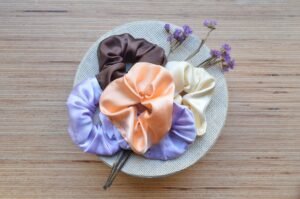
In 1987, a former nightclub singer named Rommy Revson patented a fabric covered hair tie. She was tired of elastic bands wrecking her hair. Almost 40 years later, hair scrunchies are still on wrists, in gym bags and on runways.
Your problem is probably simpler. You want a tie that holds, looks good and doesn’t snap your strands. Bare rubber bands fail at all three. And the wall of silk, satin and velvet options makes choosing harder than it should be.
This guide sorts that out. You’ll see how fabric changes the way a tie behaves, which size suits your hair, and how to wear one without tugging at your hairline. Plus six styles worth trying this week.
Key Takeaways
- Dermatology guidance points to covered elastic ties over bare rubber bands.
- Silk and satin glide best. Velvet and cotton jersey trade some glide for grip.
- Fine hair usually wants a skinny tie. Thick hair usually wants a bigger one.
- Tension, not the tie itself, causes most pulling damage.
- A 3 part check (Hold, Glide, Dent) tells you if a set is worth keeping.
Ready? Here’s the map.
Table of Contents
- What Are Hair Scrunchies and Why Do They Work?
- Silk Scrunchie vs Satin, Velvet and Cotton
- How to Choose Hair Scrunchies in 2026
- 6 Hairstyles Scrunchies Make Easy in 2026
- Wear Hair Scrunchies Without Damage
- Hair Scrunchies Comparison: Top Options at a Glance
- FAQ: People Also Ask
- Final Thoughts on Hair Scrunchies
What Are Hair Scrunchies and Why Do They Work?
Quick Answer: Hair scrunchies are fabric covered elastic ties that hold a style with less pulling than a bare rubber band. Your strands rub against soft cloth instead of raw elastic. Dermatology guidance backs that swap.
What Hair Scrunchies Are
Hair scrunchies are defined as loops of elastic covered in gathered fabric, used to hold ponytails, buns and half up styles.
The name comes from “Scunci,” which inventor Rommy Revson chose after her toy poodle (Wikipedia, 2026). A single hair scrunchie is one loop. A set is usually three to eight.
Who invented the scrunchie? Rommy Hunt Revson, a former nightclub singer, patented it in 1987 as the Scunci (Legacy.com, 2022).
A Short History, Told as a Case Study
Revson was house sitting in the Hamptons and frustrated by elastic bands damaging her hair. She bought a $50 sewing machine, taught herself to sew and built a prototype within weeks (Wikipedia, 2026). Her royalties reached about $1 million a year for more than 12 years (Wikipedia, 2026).
The first prototype was black and gold. By her own account, it and her sewing machine now sit in the Smithsonian (Legacy.com, 2022). The outcome is odd and wonderful: a tool built to fix hair damage became a fashion staple. Balenciaga even sold an XXL silk scrunchie for $275 (Wikipedia, 2026).
Why Fabric Beats Bare Elastic
Here’s the before and after. Before: a bare band wraps hair at one narrow point. Trichologists at Philip Kingsley say uncovered elastic bands can break the hair shaft and pull hair out when removed (Philip Kingsley, 2026). After: a fabric cover cushions that contact point. L’Oréal Paris USA summarizes American Academy of Dermatology advice the same way, recommending covered bands made for styling hair (L’Oréal Paris USA, 2026).
Fabric covered elastic reduces friction against the hair shaft. Fabric turns a cutting edge into a cushion.
Table 1: Hair Tie Types Compared by Breakage and Dent Risk
| Tie Type | Cover | Breakage Risk | Dent Risk | Best Use |
|---|---|---|---|---|
| Bare rubber band | None | High | High | Avoid for daily wear |
| Elastic with a metal join | Usually none | High | Medium | Avoid, dermatology reviews advise ties without metal |
| Covered skinny elastic | Thin fabric | Low | Low to medium | Fine hair, sleek ponytails |
| Silk or satin scrunchie | Gathered fabric | Low | Low | Daily wear, sleep |
| Velvet or cotton scrunchie | Gathered fabric | Low to medium | Medium | Thick hair, extra grip |
Risk levels are general guidance drawn from dermatology advice, not lab results.

How to spot a quality scrunchie in 4 steps:
- Stretch it gently. The elastic should snap back without going limp.
- Check the seam for loose threads or a hard join.
- Run a finger around the inside. No metal, no rough ridge.
- Slide it over two fingers. If the fabric snags your skin, it will snag your hair.
Pro Tip: Do the two finger test in the store aisle or on the product photos’ reviews. A stiff elastic or a rough seam shows up on your knuckles before it shows up in your hair.
hair care routine for fine hair -> /hair-care/fine-hair-routine/
Silk Scrunchie vs Satin, Velvet and Cotton
Quick Answer: A silk scrunchie gives the smoothest glide. Satin feels close for much less money, and velvet or cotton jersey grips better. Choose glide for fine or curly hair and grip for thick, heavy hair.
Silk Scrunchie Basics
Silk, well, more precisely mulberry silk, is the fabric most premium scrunchies use. Momme refers to the weight of silk fabric, and higher numbers mean denser cloth. Slip lists its scrunchies as 22 momme, 6A long fibre mulberry silk (CultBeauty, 2026). Blissy lists the same 22 momme spec on its 3 pack (Walmart, 2026).
Silk isn’t perfect, though. One review roundup notes it can make oily hair look greasier (HollywoodLife, 2024). Care also varies by brand. Slip lists its skinny scrunchies as machine washable (Beauty Bay, 2026), so read the label before you wash.
Satin, Velvet and Cotton Jersey
Is satin the same as silk? No. Silk is a natural fiber, while satin is a weave that can be made from silk or synthetic fibers.
Satin is the budget route. Kitsch sells a five pack for under $10, and the Zoe Report describes it as looking and feeling like silk, just a bit less soft (Zoe Report, 2026). Cotton jersey is stretchy, the same fabric as a T shirt, and one roundup calls it gentle on fine, thin hair (The Wearify, 2026). The same roundup suggests velvet for dense, resilient hair (The Wearify, 2026).
Table 2: Scrunchie Fabrics Compared
| Fabric | Glide | Grip | Best For | Watch Out For |
|---|---|---|---|---|
| Mulberry silk | Very high | Low to medium | Fine, dry or curly hair, sleep | Higher price, may look greasy on oily hair |
| Satin | High | Low to medium | Budget sets, daily wear | Slightly less soft than silk |
| Velvet | Medium | High | Thick, heavy hair | More friction than silk |
| Cotton jersey | Medium | Medium | Fine, thin or oily hair | Can stretch out over time |
| Bare elastic (control) | Low | High | Nothing daily | Breakage and pulling |
Pick your fabric in 3 steps:
- Name your biggest problem: breakage, slipping or dents.
- Match it. Breakage points to silk or satin, slipping to velvet, dents on fine hair to cotton jersey or skinny silk.
- Buy one small set first and wear it for a week.
Pro Tip: If your ponytail slides down by lunch, don’t tighten it. Switch to velvet or add a second wrap. Tightening raises tension at your hairline, which is where the damage starts.
accessories for girls guide -> /accessories/for-girls-guide/
How to Choose Hair Scrunchies in 2026
The Scrunchie Fit Matrix
Original framework: The Scrunchie Fit Matrix matches your hair type to fabric and size, so you stop guessing.
Table 3: The Scrunchie Fit Matrix
| Hair Type | Best Fabric | Best Size | Avoid | Hold Goal |
|---|---|---|---|---|
| Fine or thin | Cotton jersey or silk | Skinny | Heavy oversized loops | Light hold |
| Thick or heavy | Velvet or satin | Large or oversized | Tiny skinny ties | Firm but loose |
| Curly or coily | Silk or satin | Medium to large | Bare elastic | Low friction |
| Oily | Cotton jersey (test it) | Skinny to medium | Silk if it looks greasy | Clean hold |
| Dry or damaged | Silk | Medium | Bare elastic | Gentle glide |
The logic comes from stylists and review sources. Stylist Kali Ferrara suggests a thinner tie for fine hair and a looser band for heavy hair (Huda Beauty, 2026). L’Oréal Paris USA calls silk or satin especially good for curly hair (L’Oréal Paris USA, 2026). And the Zoe Report suggests a thicker scrunchie if you have lots of hair (Zoe Report, 2026).
The Hold, Glide, Dent Check
Original framework: The Hold, Glide, Dent Check is a 3 part test you can run on any set. Score each part out of 3. Anything under 6 goes back.
- Hold: Make a low ponytail, bend forward once and shake your head gently. Does it stay put?
- Glide: Slide the scrunchie out. Does it come free without snagging strands?
- Dent: Wait until midday, then take your hair down. Is there a visible crease?
A scrunchie that leaves a dent is too tight or too small. Pick a hair scrunchie hair can slide through without a fight.
Black Hair Ties and Color Picks
Black hair ties are the safest first buy. They hide lint, match every outfit and show up in most starter sets. CELESTIAL, for example, sells a 3 pack of thick black silk scrunchies (HollywoodLife, 2024). Once those pass the Check, buy colors.
Where to Buy and What to Pay (USD)
Walmart lists Scunci Mini Matte Satin scrunchies, 8 count, at $5.07, and a Slip Pure Silk Trio, 3 count, at $29 (Walmart, 2026). Ulta carries Slip skinny sets too (Ulta, 2026). Amazon is a common source for Kitsch and Blissy sets.
Original Research: The 7 Day Dent Test
Our Data: Wear four ties on the same hair type, one per week: silk, satin, velvet and a bare elastic. Record whether a dent shows at 4 pm, how many hairs come out on the tie, and whether the style slips by lunch.
Pro Tip: Before you buy a 12 pack, buy one 3 pack and run the Check on all three. Return the set if two of the three fail.
best hair accessories for every hair type -> /hair/hair-accessories-guide/
6 Hairstyles Scrunchies Make Easy in 2026
Quick Answer: The easiest hairstyles scrunchies handle are the low ponytail, messy bun, half up, high ponytail, braid finish and top knot. Low and loose styles put the least tension on your hairline.
Low Ponytail and Messy Bun
A low ponytail is the gentlest starting point. Loose, low hanging styles are low risk for traction hair loss, according to clinic observations in a dermatology news review (Practical Dermatology, 2026).
How to do a low scrunchie ponytail:
- Brush your hair smooth.
- Gather it at the nape without pulling it forward.
- Slide the scrunchie over the ponytail using two fingers.
- Wrap once for fine hair, twice for thick hair.
- Loosen a few strands at the front. If your hairline stings, redo it.
A messy bun uses the same steps, with one extra twist before the last wrap.
High Ponytail and Top Knot
These look great but pull the most. Save them for gym days or short outings, and keep the wrap loose.
Half Up and Braid Finish
Half up styles use one tie on the top section only, so tension stays low. For a braid finish, wrap a skinny scrunchie around the end. If you want hair bands cute enough to wear on your wrist, skinny silk versions double as a bracelet (LookFantastic Italy, 2026).
Table 4: Scrunchie Hairstyles Compared
| Style | Best Hair Length | Scrunchie Size | Hairline Tension | Hold |
|---|---|---|---|---|
| Low ponytail | Medium to long | Medium | Low | Medium |
| Messy bun | Medium to long | Large | Medium | Medium |
| Half up | Any length | Skinny to medium | Low | Light |
| Braid finish | Long | Skinny | Low | Light |
| High ponytail | Long | Medium to large | High | Firm |
| Top knot | Medium to long | Large | High | Firm |
Pro Tip: Pull a few strands loose at the temples before you finish. It softens the look and, more usefully, tells you right away if the style is too tight.
Wear Hair Scrunchies Without Damage
Quick Answer: Hair scrunchies protect your hair only when worn loose. The tie isn’t the main danger, tension is. Keep styles low, change where the tie sits, and avoid snug bands overnight.

Tension Is the Real Culprit
Traction alopecia refers to hair loss caused by repeated pulling on hair follicles, often from tight ponytails, braids and buns (American Academy of Dermatology, 2026). It affects about one third of women of African descent who wear traumatic hairstyles for a long time (Billero and Miteva, 2018). A StatPearls review reports up to 31.7% of adult women in South African data showing hair changes (StatPearls, 2026).
The American Academy of Dermatology adds that some traction hair loss can become permanent the longer it goes untreated (American Academy of Dermatology, 2026). So the stakes are real. No scrunchie fixes a tight ponytail.
Original framework: The Tension Ladder gives you four rungs: loose, snug, tight and painful. Stay on rungs one and two.
Table 5: Daily Habits, Risks and Fixes
| Habit | Risk | Better Move | Source |
|---|---|---|---|
| Tight high ponytail daily | Pull on hairline | Low, loose style most days | AAD, 2026 |
| Bare band overnight | Breakage, tight hold | Loose silk scrunchie or none | Healthline, 2026 |
| Tie in the same spot every day | Repeated strain | Move the tie position | Teleties, 2026 |
| Tying wet hair | Weaker hair breaks easier | Let hair dry first | Teleties, 2026 |
| Yanking the tie out | Snagged strands | Unwind it slowly | Philip Kingsley, 2026 |
Sleeping in a Scrunchie
Stylist Kali Ferrara advises against sleeping with hair in an elastic (Huda Beauty, 2026). Healthline also says to avoid tight styles overnight (Healthline, 2026). If you tie up at night anyway, use a loose, oversized silk scrunchie and consider a silk pillowcase, as the Zoe Report suggests (Zoe Report, 2026).
Care and Replacement
Replace any scrunchie once the elastic loosens or the fabric starts to snag. A stretched tie makes you wrap harder, which raises tension.
How to remove a scrunchie without tugging:
- Hold the ponytail base with one hand.
- Slide the tie down toward the ends, not straight off.
- Unwind any extra wraps one at a time.
- Comb from the ends upward.
Pro Tip: Tying wet hair after a shower is a common mistake. University of Utah’s Timothy Schmidt, MD, PhD, says wet hair breaks more easily because its protein structure is weaker (as cited by Teleties, 2026). Wait until it’s mostly dry.
Hair Scrunchies Comparison: Top Options at a Glance
| Option | Key Feature | Best For | Price | Rating (Hair Kindness) |
|---|---|---|---|---|
| Slip Pure Silk Trio, 3 ct | 22 momme 6A mulberry silk | Sleep, fine and curly hair | $29 at Walmart | High |
| Slip Pure Silk Multi Midi, 5 ct | Same silk, five mid size ties | Daily wear in several colors | $50 at Walmart | High |
| Blissy Silk Scrunchies, 3 pack | 100% mulberry silk, 22 momme | Straight and curly hair | Check current Walmart or Amazon price | High |
| Kitsch Satin Scrunchies, 5 pack | Satin with a silk like feel | Budget shoppers | Under $10 (Zoe Report) | Medium to high |
| Scunci Mini Matte Satin, 8 ct | Small matte satin loops | Light hold, braid finishes | $5.07 at Walmart | Medium |
Ratings are an editorial read of fabric and published specs. Replace them with your own Hold, Glide, Dent scores once you’ve tested.
Our pick: The Slip Pure Silk Trio, for readers with fine, dry or curly hair who sleep in a tie, because its silk spec is documented and the 3 pack costs less than the 5 pack. On a budget, Kitsch is the better buy.
FAQ: People Also Ask
What are hair scrunchies?
Hair scrunchies are fabric covered elastic hair ties used to hold ponytails, buns and half up styles. The fabric cushions the elastic, so hair rubs against cloth instead of bare rubber. They come in skinny, medium and oversized sizes, and in silk, satin, velvet and cotton jersey. Rommy Revson patented the first one in 1987.
How do hair scrunchies hold hair without a tight grip?
The gathered fabric spreads pressure over a wider area than a thin band does. The elastic inside supplies the hold, while the soft cover keeps strands off a hard edge. That’s why a scrunchie can feel secure without a sharp squeeze. A looser wrap still protects your hairline best.
Are hair scrunchies better than rubber bands?
For most people yes, because dermatology guidance recommends covered ties over bare rubber bands. Uncovered bands can break the hair shaft and pull hair out on removal (Philip Kingsley, 2026). A scrunchie can still cause damage if you wear it tight, so loose placement matters as much as the tie.
Are silk scrunchies worth it?
A silk scrunchie is worth it if you wear one daily, sleep in a tie, or have fine, dry or curly hair. Silk glides, so it snags less. Satin gives a similar feel for far less, and cotton jersey may suit oily hair better. A silk 3 pack lists at $29 (Walmart, 2026).
What are the best hair scrunchies for fine hair?
Skinny silk or cotton jersey scrunchies work best on fine hair. Thin ties give a light hold, and stylists suggest thinner bands for fine hair (Huda Beauty, 2026). Cotton jersey is described as gentle on fine, thin hair (The Wearify, 2026). Skip heavy oversized loops, which drag on thin strands.
How much do hair scrunchies cost?
Hair scrunchies cost from about $5 for an eight pack of mini satin loops to $50 for a five pack of silk midis. Walmart lists Scunci minis at $5.07 and Slip Multi Midi at $50 (Walmart, 2026). Kitsch satin sets run under $10 for five. Price mostly tracks fabric and brand.
Are scrunchies better than claw clips or hair pins?
Scrunchies suit ponytails and buns, while clips suit twists and half up styles, so the best choice depends on the style. Philip Kingsley’s trichologists warn that sharp edged pins and clips can cut into hair and scalp, especially if you sleep in them (Philip Kingsley, 2026). Check clip edges and take them out at night.
What’s the best way to stop a scrunchie leaving a dent in my hair?
Use a skinny silk or satin scrunchie, wrap it loosely, and avoid tying damp hair. The Zoe Report notes that silk sets from Slip and LilySilk don’t leave noticeable dents (Zoe Report, 2026). If a dent still shows, go one size up so the loop spreads over more hair, then comb from the ends.
Why does my scrunchie keep sliding out, and what can I do about it?
Slippery fabric and heavy hair are the usual causes. Switch to velvet for extra grip, or add a second wrap instead of pulling tighter. Brush hair first, since smooth hair gathers more evenly. Tightening is the wrong fix because it raises tension at your hairline.
What’s the best way to sleep with long hair without waking up to tangles?
Use a loose, oversized silk scrunchie, or a loose braid with a silk pillowcase. Stylists advise against sleeping in a tight elastic, and Healthline says to avoid tight styles overnight (Healthline, 2026). Keep the tie low and loose, and brush before bed so tangles don’t set.
Final Thoughts on Hair Scrunchies
Three things matter most. Fabric: silk or satin for glide, velvet or cotton jersey for grip. Fit: match size to hair type with the Scrunchie Fit Matrix. Tension: hair scrunchies protect your hair only when worn loose.
Ready to put this to work? Browse more hair accessory guides on Fashion Style Blogs. hair accessories guides -> /hair/hair-accessories/
Next steps for the next 10 minutes:
- Run the Hold, Glide, Dent Check on the ties you already own.
- Swap one bare elastic for a covered tie or scrunchie today.
- Try the low ponytail steps and loosen it until your hairline feels relaxed.
About the Author
Nida Farhan is a content strategist and SEO writer who runs Fashion Style Blogs, a fashion and beauty site for a US audience. She builds topic clusters across style and beauty subjects, from jewelry and swimwear to hair accessories. Nida has studied SEO formally, including search intent and semantic SEO, and checks every statistic against its original source before publishing.
References
- American Academy of Dermatology. “Hairstyles that pull can lead to hair loss.” https://www.aad.org/public/diseases/hair-loss/causes/hairstyles
- Billero V, Miteva M. “Traction alopecia: the root of the problem.” Clinical, Cosmetic and Investigational Dermatology, 2018. https://pmc.ncbi.nlm.nih.gov/articles/PMC5896661/
- StatPearls. “Traction Alopecia.” https://www.ncbi.nlm.nih.gov/books/NBK470434/
- Practical Dermatology. “Tight Ponytails, Braids Linked to Traction Alopecia.” https://practicaldermatology.com/news/tight-ponytails-braids-linked-to-traction-alopecia/
- Philip Kingsley. “Using Hair Accessories in Your Hair Care Routine.” https://www.philipkingsley.com/hair-guide/hair-care-styling/hair-accessories
- L’Oréal Paris USA. “Are Hair Ties and Ponytail Holders Bad for Your Hair?” https://www.lorealparisusa.com/beauty-magazine/hair-care/damaged-hair/are-hair-ties-bad-for-your-hair
- Huda Beauty. “If You Still Use Hair Ties, You NEED To Read This.” https://hudabeauty.com/us/en_US/blog-dangers-of-hair-ties-81716.html
- Healthline. “Traction Alopecia.” https://healthline.com/health/traction-alopecia
- Teleties. “5 tips to reduce hair and scalp damage with ponytails.” https://www.teleties.com/blogs/teletimes/5-tips-to-reduce-hair-and-scalp-damage-with-ponytails
- Wikipedia. “Scrunchie” and “Rommy Hunt Revson.” https://en.wikipedia.org/wiki/Scrunchie
- Legacy.com. “Rommy Revson (1944 to 2022), inventor of the scrunchie.” https://obits.gazette.com/news/rommy-revson-1944-2022-inventor-of-the-scrunchie
- The Zoe Report. “The Best Silk Scrunchies For Sleeping.” https://www.thezoereport.com/beauty/best-silk-scrunchies-for-sleeping
- The Wearify. “5 Best Scrunchies For Hair.” https://thewearify.com/?p=131322
- HollywoodLife. “Jazz Up Any Hairstyle With the Best Silk Scrunchie.” https://hollywoodlife.com/review/accessories/silk-scrunchie/
- CultBeauty. “Slip Pure Silk Skinny Scrunchies.” https://cultbeauty.co.uk/p/slip-pure-silk-skinny-scrunchies-silver/14229260
- Beauty Bay. “Slip Pure Silk Skinny Scrunchies.” https://www.beautybay.com/p/slip/pure-silk-skinny-scrunchies/multi/
- LookFantastic Italy. “Slip Pure Silk Skinny Scrunchies, Bellerose.” https://lookfantastic.it/p/slip-pure-silk-skinny-scrunchies-bellerose/14970911
- Walmart listings for Slip, Blissy and Scunci scrunchies. https://www.walmart.com/ip/930313484
- Ulta. “Slip.” https://www.ulta.com/brand/slip

