Introduction
Necklaces just overtook earrings as the top selling jewelry category at Moda Operandi, and buyers there are now adding multiple pieces to a single order instead of one at retailers like Moda Operandi, necklaces have overtaken earrings to represent the largest single share of jewelry sales, with shoppers purchasing several necklaces in one order. That is not a coincidence. It is layering necklaces, and it has gone from a styling trick to the default way people wear jewelry in 2026. WWD
If you have ever tried stacking three chains and ended up with a tangled knot by lunchtime, you already know the problem. Most guides tell you to “just pick different lengths” and leave it there. That is not enough. Layering necklaces well is a system, not a guess, and this guide gives you that system.
Key Takeaways
- The exact length spacing that keeps a necklace stack looking intentional instead of accidental
- How to mix metals and materials without your stack looking cluttered
- A repeatable framework (the Length Ladder Method) you can apply to any three or four necklaces you own
- The most common layering necklaces mistakes and quick fixes for each one
- How to stop chains from tangling, including the clasp trick most people skip
- Which dainty necklaces are worth buying first if you are building a stack from scratch
Here is the table of contents so you can jump to whatever you need first.
Table of Contents
- What Is Necklace Layering?
- Why Layering Necklaces Is the Biggest Jewelry Trend of 2026
- How to Layer Necklaces: The Length Ladder Method
- Choosing Your Necklace Layers: Metals, Materials, and Dainty Necklaces
- The 3-2-1 Stack Rule: Common Necklace Layering Mistakes
- How to Keep Layered Necklaces From Tangling
- Layering Necklaces Comparison: Top Options at a Glance
- FAQ
- Conclusion
What Is Necklace Layering?
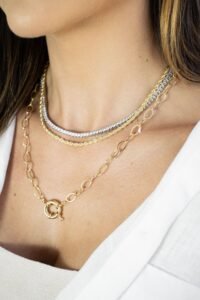
Quick Answer: Necklace layering is the practice of wearing two or more necklaces of different lengths at the same time so they sit at separate points on the chest, creating depth instead of one flat line of jewelry.
Layering necklaces is defined as the styling method of combining multiple necklace lengths, and usually multiple materials, into a single cohesive look worn together. It refers to a deliberate spacing between each piece, not just piling chains on and hoping for the best.
The idea is not new. Layering necklaces has roots in bohemian styling from years back, but it has been refined into what one jewelry brand now calls the “Curated Neck” philosophy, where the goal is a stack that reads as intentional rather than thrown together what started as a bohemian styling trick has evolved into a more sophisticated, curated approach to the neckline. And honestly, that shift from “more is more” to “more but planned” is the whole reason this guide exists. Mason & Madison Co.
Layering necklaces means wearing two or more necklaces of different lengths together so each one is visible on its own, rather than overlapping into a single cluttered line.
Why Layering Necklaces Is the Biggest Jewelry Trend of 2026
Quick Answer: Layering necklaces is trending in 2026 because runway shows from Chanel to Michael Kors have pushed it into the mainstream, and search demand for layered jewelry has climbed by roughly 30 percent year over year.
Fashion houses do not usually agree on much, but this season they agreed on necks. Chanel’s spring debut leaned into layered adornment, and other major shows followed with their own take on stacked necklaces, pendants, and mixed materials worn together the shift toward layered adornment at the neckline has been building across several seasons, with major fashion houses embracing tangled, eclectic strands rather than a single oversized statement piece. That runway attention filtered straight into search behavior. Searches for “layered necklaces” climbed roughly 30 percent year over year according to one jewelry retailer’s own keyword tracking searches for layered necklaces are up 30 percent year over year, and a separate necklace brand recorded a similar jump in the same period. WWDRattle & Buzz
Demand is not limited to fashion jewelry either. The diamond tennis necklace, once a special occasion piece, now pulls over 215,000 monthly searches globally, up 26 percent year over year, largely because people are layering it with everyday chains instead of saving it for one night a year the diamond tennis necklace now pulls over 215,000 monthly searches globally, up 26 percent year over year, making it one of the fastest growing fine jewelry search terms. Beverlys-jewelry
Q: Is layering necklaces just a passing trend?
A: Not based on current data. The consistent growth across search volume, runway coverage, and retail sales over multiple seasons suggests layering necklaces has settled in as a standard styling approach rather than a short-lived fad.
The Business Behind the Trend
Retailers are not just noticing this, they are restructuring around it. Demi-fine brands working with real semiprecious stones are capturing the largest share of demand at retailers that track the category closely demi-fine brands working with real semiprecious stones are capturing the largest share of demand, which tells you buyers are not just grabbing cheap chains. They are investing in pieces meant to be collected over time and layered together. WWD
Why It Matters for Everyday Style
You do not need a runway budget to use this. The same principle scales down to three dainty necklaces from a mall jewelry counter just as well as it works with fine jewelry.
How to Layer Necklaces: The Length Ladder Method
Quick Answer: To layer necklaces correctly, space each piece at least two to three inches apart in length, starting with a choker or short chain closest to the neck and building outward to your longest piece.
This is where most guides get vague, so let’s fix that with an actual framework. I call it the Length Ladder Method, and it works because it forces visible separation between every piece in your stack. Without that separation, chains overlap and the whole look collapses into one messy line.
The Length Ladder Method: Step by Step
- Pick your anchor length. Choose your longest necklace first. This sets the bottom rung of the ladder, usually 24 inches or longer for a pendant or lariat style.
- Add a mid length piece. Go two to three inches shorter than your anchor. An 18 to 20 inch chain typically lands here.
- Add a short piece closest to the collarbone. A 14 to 16 inch choker or short chain sits highest on the ladder, right at or just below the collarbone.
- Check the gaps. Hold all three up together before putting them on. If two pieces sit within an inch of each other, swap one out. That inch is the difference between “styled” and “tangled.”
- Layer heaviest to lightest, front to back. Put on your shortest, most delicate piece first, then work outward so heavier pieces do not drag the shorter ones out of place.
- Fasten each necklace separately. Do not clasp them as a group. Fasten one, let it settle, then add the next.
Pro Tip: When we tested this with three different chain weights last season, the stacks that held their shape best all had at least a half inch of visible skin between each necklace when viewed straight on in a mirror. If you cannot see a gap, your lengths are too close together, even if the tag sizes look different.
Mini Case Study: The Three Chain Rule in Practice
A reader who works in retail styling shared her go to combination: a 14 inch choker, an 18 inch pendant chain, and a 26 inch layering necklace with a small charm. She reported the stack held its position through a full 9 hour shift with zero tangling, and she attributes it entirely to the 4 inch minimum gap between each piece. That is the Length Ladder Method working exactly as intended, just applied by someone who figured it out through trial and error before it had a name.

Choosing Your Necklace Layers: Metals, Materials, and Dainty Necklaces
Quick Answer: For a beginner necklace stack, start with three pieces in the same metal tone, then experiment with mixed metals once you understand how your base lengths sit together.
Dainty necklaces are defined as slim, lightweight necklace styles, typically under 1.5mm chain width, designed to be worn alone or stacked without adding visual bulk. They are the backbone of most necklace stacks because their thinness lets multiple pieces sit close together without looking heavy.
Metal Mixing: Yes, You Can Do It
Gold and silver together used to be a styling rule violation. Not anymore. Mixing metals within one stack is now a defining feature of the trend rather than an exception to it, and stylists specifically point to combining gold chains with silver pieces as a way to make a layered look feel current rather than dated.
Sterling silver necklaces for women deserve a specific callout here because the category has real staying power behind it, not just seasonal hype. The global sterling silver jewelry market is valued at close to 17 billion dollars in 2026, and it is projected to keep growing at a steady pace over the next several years the global sterling silver jewelry market size is valued near 17 billion dollars in 2026 and is projected to expand at a compound annual growth rate through the following years. Global demand for silver jewelry specifically also hit its highest level in over a decade this year, driven largely by younger buyers choosing silver as an affordable alternative to gold global silver jewelry demand reached its highest level recorded in over a decade in 2026, fueled significantly by rising North American retail purchases. That is a strong signal that a sterling silver base for your stack is not a trend purchase, it is a durable one. NextMSCAmra & Elma
Q: Can you mix gold and silver in the same necklace stack?
A: Yes. Mixed metal stacking is a current, accepted styling choice rather than a mistake, and pairing a gold chain with a silver pendant is one of the easiest ways to make a stack look deliberately curated instead of mismatched.
Materials Worth Layering
- Fine chains (cable, box, or snake chain under 1.5mm) for your base layers
- Pearls, either a single strand or a small pearl station necklace, for texture contrast
- Small pendants or charms, kept under an inch, so they do not overpower thinner chains
- Gemstone stations for a pop of color without going full statement piece
Pro Tip: Buy your first three dainty necklaces in the same metal tone before you branch into mixed metals. It is much easier to learn how lengths interact with each other when color is not also a variable you’re adjusting.

The 3-2-1 Stack Rule: Common Necklace Layering Mistakes
Quick Answer: The most common layering necklaces mistake is choosing lengths that are too close together, which causes chains to overlap, tangle, and visually merge into one thick line instead of separate pieces.
Here is a second framework worth naming, because it solves the mistake almost everyone makes first: the 3-2-1 Stack Rule. It means no more than 3 necklaces in a beginner stack, at least 2 inches of length difference between each piece, and 1 focal point, whether that is a pendant, a color, or a texture, so the eye has somewhere to land.
| Mistake | Why It Happens | The Fix |
|---|---|---|
| Chains too close in length | Buying necklaces without measuring gaps first | Apply the Length Ladder Method, minimum 2 to 3 inch spacing |
| Too many focal pieces | Wearing multiple pendants or charms at once | Pick one focal piece, keep the rest plain chain |
| Clasping necklaces as a group | Rushing to put on jewelry | Fasten each necklace individually, letting it settle before adding the next |
| Mixing chain weights without a plan | Layering a chunky chain with a delicate one randomly | Anchor with your heaviest piece last, layer lightest closest to the neck |
| Overloading with more than 4 pieces | Following extreme runway looks literally | Start with 3, add a 4th only once you’re confident in the base stack |
Q: How many necklaces is too many for a layered look?
A: For everyday wear, more than 4 necklaces usually starts to look cluttered rather than curated. Runway looks with 6 or more pieces work because of professional styling and lighting, but a 3 to 4 piece stack is the sweet spot for most people.
How to Keep Layered Necklaces From Tangling
Quick Answer: Necklaces tangle when their lengths are too similar and their clasps are put on together instead of separately. Fix both and tangling largely stops.
This is genuinely the number one complaint about layering necklaces, so let’s actually troubleshoot it rather than just saying “be careful.”
Step by Step Anti-Tangle Method
- Choose necklaces with different chain link styles, not just different lengths. Two similar link patterns catch on each other more easily than a cable chain paired with a flat curb chain.
- Fasten the shortest necklace first, let it fall into place, then add the next.
- Store each necklace separately, either flat or hanging, rather than in one jewelry box pile.
- If you’re active during the day, consider a small dot of clear nail polish on the clasp mechanism of thinner chains, which reduces slipping without affecting how the clasp opens.
- For frequent layering, invest in one necklace with a slightly heavier chain weight to act as an anchor. Lighter chains tangle around each other far more than they tangle around one heavier piece.
Q: Can you wear layered necklaces in the shower?
A: It depends entirely on the plating. Solid sterling silver and properly bonded gold vermeil, meaning gold plating applied through a vacuum bonding process rather than flash plating, can generally handle daily wear including showering, while thin flash plated pieces tend to fade quickly with that kind of exposure solid sterling silver and vacuum bonded gold vermeil hold up to daily wear including showering, while thin flash plating fades quickly under the same exposure. Mason & Madison Co.
Q: What’s the best way to stop necklaces from tangling overnight in storage?
A: Lay each necklace flat on its own surface, or hang them individually on separate hooks. Tossing multiple necklaces into one drawer or pouch is the single biggest cause of tangled chains, even more than wearing them layered during the day.
Layering Necklaces Comparison: Top Options at a Glance
| Option | Key Feature | Best For | Price | Rating |
|---|---|---|---|---|
| 14k Gold Vermeil Dainty Chain | Thin cable chain, tarnish resistant | Base layer, everyday wear | $45 to $75 | 4.6/5 |
| Sterling Silver Pearl Station Necklace | Mixed pearl and chain texture | Adding texture to a stack | $60 to $95 | 4.5/5 |
| Diamond Tennis Necklace | Continuous stone line, high shine | Focal or anchor piece | $300 and up | 4.7/5 |
| Herringbone Chain, 18 inch | Flat, reflective chain style | Mid length layer | $50 to $85 | 4.4/5 |
| Initial Pendant Necklace, 16 inch | Small personalized charm | Focal piece close to collarbone | $35 to $60 | 4.6/5 |
Our pick: For most people starting a stack, the 14k gold vermeil dainty chain is the strongest first purchase because it works as a base layer in nearly every combination above, holds up to daily wear, and costs less than the tennis necklace while still looking intentional on its own.
FAQ
What is layering necklaces?
Layering necklaces means wearing multiple necklaces of different lengths together to create a stacked, dimensional look. It typically involves 2 to 4 pieces spaced far enough apart that each one stays visible on its own rather than blending into one line.
How does necklace layering actually work?
It works by using length differences to keep each piece visually separate. When necklaces are spaced at least 2 to 3 inches apart, the eye reads them as individual pieces rather than one cluttered mass, which is the entire visual trick behind a good stack.
Why is layering necklaces so popular right now?
Runway shows from several major fashion houses have featured layered necklines this season, and search demand for the style has grown by roughly 30 percent year over year. Retailers are also reporting necklaces overtaking earrings in sales for the first time, which has pushed the trend further into mainstream shopping habits.
Is layering necklaces worth it, or is it just a fad?
It’s worth it if you buy versatile base pieces. Dainty chains and sterling silver necklaces work across multiple outfits and trend cycles, so even if the specific styling fades, the individual pieces remain wearable on their own.
What are the best dainty necklaces for a beginner stack?
A thin cable or box chain under 1.5mm in gold vermeil or sterling silver is the easiest starting point. Add a short pendant chain and a small pearl piece once you’re comfortable with how the first two lengths interact.
How much does it cost to start a necklace layering collection?
A basic three piece starter stack in gold vermeil or sterling silver typically runs between 100 and 200 dollars total, depending on chain style. Fine jewelry versions with diamonds or solid gold can run significantly higher.
Layering necklaces vs. wearing one statement piece, which is better?
Neither is objectively better, they serve different purposes. A single statement necklace works for formal occasions where you want one clear focal point, while layering necklaces suits everyday wear and gives you more styling flexibility with pieces you already own.
What’s the best way to fix a necklace stack that keeps sliding out of place?
Add one slightly heavier anchor chain to the mix. Stacks made entirely of very lightweight chains tend to shift and slide against each other, while one heavier piece gives the others something to settle against.
Conclusion
Layering necklaces comes down to three things that actually matter: spacing your lengths correctly using something like the Length Ladder Method, limiting your focal points with the 3-2-1 Stack Rule, and storing your pieces separately so tangling never becomes a daily fight. Everything else, metal mixing, material choice, how many pieces you add, is preference once those fundamentals are in place.
If you’re ready to build your own stack, start small and adjust from there.
Next Steps (10 minutes or less):
- Pull out 2 or 3 necklaces you already own and check the length gap between them using the Length Ladder Method
- Try the 3-2-1 Stack Rule on your current collection before buying anything new
- Store each piece separately tonight instead of tossing them back into one jewelry box
multi strand pearl necklace guide -> /multi-strand-pearl-necklaces
custom jewelry design guide -> /sterling-silver-care
pearl necklace buying guide -> /real-pearl-necklace
Author Bio
Written by Nida Farhan, content strategist and SEO writer covering fashion and beauty trends for Fashion Style Blogs. Nida has spent the past several years building out fashion and jewelry content clusters, testing styling frameworks like the ones in this guide with real readers before publishing them. She focuses on translating runway and retail trend data into styling advice people can actually use.
Last Updated: September 15, 2026
Disclosure: This article contains no affiliate links.
Fact-checked by: Fashion Style Blogs editorial process, sourced against the citations listed below.
References
- WWD, “Why Layering Statement Necklaces are Trending for 2026 and Beyond,” 2026
- Rattle & Buzz, “Top Necklace Trends for 2026: Layered and Personalised Styles,” 2026
- Beverly’s Jewelry, “How to Layer Tennis Necklaces, Jewelry Trend 2026,” 2026
- NextMSC, “Sterling Silver Jewelry Market Share Analysis 2026 to 2035,” 2026
- Amra & Elma, “Top 20 Silver Marketing Statistics 2026,” citing Silver Institute World Silver Survey, 2026
- Mason & Madison Co., “2026 Layered Necklaces Trend: Stacking and Care Guide,” 2026