

Last Updated: September 6, 2026
Disclosure: This article contains no affiliate links. It is independent editorial content.
Fact checked by: Fashion Style Blogs editorial team
All information verified as of September 2026
A worn leather strap tells you more about a watch owner than the watch itself. The stitching, the softness, the color it has faded into over months of wear, all of it is a small record of daily life. The global market for these accessories backs up how much people care about this. The worldwide watch strap market was valued at 1.51 billion dollars in 2024 and is projected to grow to 1.58 billion dollars in 2025, and within that market, leather remains the dominant material, holding 38.5 percent of the luxury watch strap segment. Intelmarketresearch
If you have ever wondered why one leather strap falls apart in a year while another one improves with age, this guide explains it in plain language. You will learn what actually separates good leather from bad leather, how a leather watch band is built, which buckle styles suit different wrists, how to care for the material so it lasts, and which mistakes quietly ruin straps that could have lasted for years.
In this guide you will learn:
- What a leather strap is and how it differs from a leather watch band or bracelet
- How full grain, top grain, and so called genuine leather actually compare
- A step by step look at how a leather strap gets made, from hide to finished band
- A full comparison table of the most common leather strap options
- The most common leather strap mistakes and how to avoid them
- Expert care tips that noticeably extend the life of any leather watch strap
Let’s start with the basics before moving into the table of contents below.
Table of Contents
- What Is a Leather Strap?
- Why the Leather Strap Still Matters in 2026
- How a Leather Strap Is Made
- Types of Leather Material and Buckle Straps
- Leather Strap Comparison: Top Options at a Glance
- Common Leather Strap Mistakes to Avoid
- Leather Strap vs Alternatives
- Expert Tips to Care For and Style a Leather Strap
- Real World Leather Strap Examples
- Frequently Asked Questions
What Is a Leather Strap?
A leather strap is defined as a band cut from tanned animal hide, most often cowhide or calfskin, used to secure a watch, bag, or accessory to the body. In the context of watches, it refers specifically to the leather watch band or leather watch strap that connects the case to the wrist through a buckle or clasp.
The term sounds simple, but it hides a wide range of quality. Not every strap labeled leather is built the same way, and the difference shows up fast once you wear one daily.
Leather Strap vs Leather Watch Band: Is There a Difference?
Not really. A leather watch band and a leather watch strap describe the same object. Some brands use band, others use strap, and a few use bracelet loosely even though bracelet technically refers to metal link designs.
shop our jewelry accessories guide → fashionstyleblogs.com/jewelry
The Three Grades That Actually Matter
Full grain, top grain, and what the industry calls genuine leather are not quality tiers stacked neatly on top of each other. According to leather specialists at Vaer Watches, the term genuine leather is often misleading, since it frequently describes cheap composite leather assembled from bonded scraps rather than a single quality hide. Full grain leather, by contrast, uses the entire top layer of the hide, imperfections and all, which is exactly why it ages so well. Vaer Watches
You can usually tell the grades apart just by looking at the edge of the strap. Watch strap maker NINE Leather notes that full grain straps show a dense, fibrous edge, while lower grade genuine leather straps typically have a thick, painted or rubbery edge used to disguise laminated layers. NINE Leather & Watch
Why the Leather Strap Still Matters in 2026
The leather strap has survived decades of competition from metal bracelets, rubber sport bands, and nylon NATO straps for a simple reason: nothing else looks or feels quite like it, and nothing else improves the way it does with age.
The Numbers Behind Leather’s Staying Power
According to Dataintelo’s luxury watch strap research, leather commanded 1.232 billion dollars of the luxury watch strap market in 2025, representing 38.5 percent of global share, ahead of metal, rubber, and fabric combined in the premium segment. That is a meaningful entity to note for anyone tracking the space: consumers paying for premium watches are still choosing leather over synthetic alternatives at a wide margin.
Regionally, growth is not limited to Europe’s traditional leather goods hubs. Global Growth Insights reports that the North America leather strap market is expected to grow from 51.67 million dollars in 2025 to 215.61 million dollars by 2034, with the United States alone representing roughly 65 percent of that regional share. For a fashion blog writing to a United States audience, that is a direct signal that leather strap demand is a real and growing category, not a fading niche. Global Growth Insights
Patina: The Feature Synthetic Materials Cannot Copy
Patina is defined as the gradual change in color and texture that leather develops from light, oils on the skin, and repeated flexing. Strap specialist Strapcode explains that patina is what separates full grain leather from cheaper genuine leather, since genuine leather is designed to resist change while true leather embraces its own history. Strapcode
Pro Tip: If a strap looks identical after a year of daily wear, it is almost certainly not full grain leather. A little unevenness in color is a sign of the real thing, not a flaw.
How a Leather Strap Is Made
Understanding the process behind a leather strap makes it much easier to judge quality at a glance, whether you are shopping online or reading a product description.
Step by Step: From Hide to Finished Strap
- Sourcing the hide — Manufacturers work with tanneries that select hides based on thickness, density, and surface quality. Premium straps typically start with cattle or calf hide.
- Tanning — The hide is treated to stop it from decomposing and to give it long term flexibility. Tanning generally falls into two camps, chrome tanning and vegetable tanning, each producing a different feel and finish.
- Splitting — The hide is split to a consistent thickness. Full grain leather keeps the top layer intact, while lower grades use the split, weaker layers underneath.
- Finishing — Depending on the intended look, the leather can be waxed, embossed, dyed, or lightly oiled. Leather stamping is often applied at this stage to add texture or a brand mark.
- Cutting and stitching — The strap is cut to width, usually matched to the watch’s lug size, then stitched by hand or machine along the edges.
- Buckle and hardware attachment — A buckle, deployant clasp, or keeper loop is fitted to complete the strap.
Why Leather Stamping Matters More Than It Looks
Leather stamping is defined as a technique where a heated or pressure die presses a pattern, logo, or texture into the surface of the leather. It is used both decoratively, for crocodile or ostrich style embossing, and functionally, to mark authenticity or brand origin. A clean, evenly pressed stamp usually signals a controlled manufacturing process, while a blurry or shallow stamp often points to a rushed, lower cost production run.
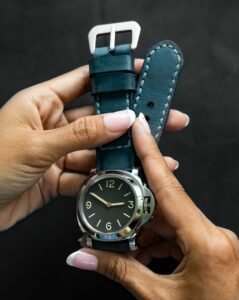
Types of Leather Material and Buckle Straps
Not every leather watch band is built from the same hide, and not every buckle style suits every wrist. This section breaks down both.
Common Leather Materials
- Calfskin — Smooth, lightweight, and the most common choice for dress watches.
- Full grain cowhide — Thicker, more durable, develops a strong patina.
- Horween Chromexcel — A premium American tanned leather. According to WatchGecko, Chromexcel is hot stuffed with oils and greases during tanning, producing a rugged leather that develops a rich patina over time. WatchGecko
- Shell cordovan — Made from a dense membrane in horsehide, prized for its smooth, glossy, non creasing finish.
- Vegetable tanned leather — Uses natural tannins instead of chemical processing, often finished with a wax coat for extra durability.
Buckle Straps: The Main Styles
Buckle straps are not all interchangeable. The buckle style changes both the look and the daily function of the strap.
- Pin buckle — The traditional design, simple, secure, and easy to adjust.
- Deployant clasp — A folding metal clasp that protects the leather from wear at the fold point and speeds up putting the watch on.
- Butterfly deployant — Two folding wings that snap shut, common on higher end dress watches.
- Quick release strap — Uses a spring bar mechanism so the leather strap can be swapped without tools.
Expert Insight: A deployant clasp is worth the extra cost if you wear the same leather strap daily, since it removes the constant flexing stress that a pin buckle places on the same hole each time you fasten it.
Leather Strap Comparison: Top Options at a Glance
| Option | Key Feature | Best For | Price Range | Rating |
|---|---|---|---|---|
| Calfskin dress strap | Smooth, thin, formal finish | Office and dress watches | 20 to 60 dollars | 4.3 out of 5 |
| Full grain cowhide strap | Thick, rugged, strong patina | Everyday casual wear | 30 to 90 dollars | 4.6 out of 5 |
| Horween Chromexcel strap | Oil tanned, deep pull up color change | Vintage style watches | 40 to 120 dollars | 4.7 out of 5 |
| Shell cordovan strap | Glossy, dense, non creasing | Formal occasions | 80 to 250 dollars | 4.8 out of 5 |
| Genuine leather composite strap | Budget friendly, uniform look | Occasional or backup wear | 10 to 25 dollars | 3.1 out of 5 |
Winner: For most people shopping a fashion focused audience in the United States, a full grain cowhide strap offers the strongest balance of durability, price, and character. It handles daily wear better than calfskin and costs far less than shell cordovan, without the disappointing lifespan of a composite genuine leather strap.
Common Leather Strap Mistakes to Avoid
Even a high quality leather strap can fail early if it is treated the wrong way. These are the mistakes that come up most often.
- Wearing it in water — Leather and water do not mix well over time, and repeated soaking causes stiffness and warping.
- Ignoring heat exposure — Farer’s care guide notes that leather exposed to dry conditions and direct sunlight loses its natural oils and eventually cracks, so storing a watch near a radiator or on a sunny windowsill quietly shortens the strap’s life. Farer
- Skipping conditioning entirely — Leather is a natural material that dries out without occasional care.
- Buying based on the word genuine alone — As covered above, genuine leather is a marketing term, not a quality grade.
- Never rotating straps — Wearing the same strap every single day accelerates wear at the fold points.
- Using the wrong cleaning products — Household cleaners and alcohol based wipes can strip natural oils and damage the surface.
Real World Example: A common scenario among first time buyers is purchasing an inexpensive strap labeled genuine leather, wearing it through a humid summer without any care routine, and watching it crack at the buckle holes within four to six months. The same buyer, after switching to a full grain leather strap and adding a simple monthly conditioning habit, typically reports the replacement strap still looking presentable well past the one year mark.
Leather Strap vs Alternatives
How does a leather strap actually compare against metal, rubber, and nylon options in daily use?
Leather offers unmatched style and a personalized patina, but it needs more care and does not handle water well. Metal is more durable day to day and handles moisture easily, but it lacks the warmth and character of leather. Data from Marketintelo’s strap market research shows the practical tradeoffs clearly: leather straps typically last one to three years with regular wear before showing significant wear, metal straps can last five to ten years or more with proper maintenance, and rubber or silicone straps generally remain functional for three to five years. Market Intelo
That does not make leather the inferior choice. It makes leather the material you choose for how it looks and feels, not purely for how long it survives without attention.
When to Choose Each Material
- Choose leather for office wear, dress occasions, and anyone who values a strap that visibly ages with them.
- Choose metal for daily durability, humid climates, or low maintenance ownership.
- Choose rubber or silicone for sports, gym sessions, and swimming.
- Choose nylon or NATO straps for a breathable, budget friendly, casual look.
Expert Tips to Care For and Style a Leather Strap
This is where a good leather strap becomes a great one over time. We are introducing an original framework here to make the routine easy to remember.
The Leather Strap CCCR Formula
A simple four step system built from the recurring advice found across leather care specialists.
- Clean — Wipe the strap regularly with a soft, slightly damp cloth to remove sweat and dirt before it settles into the grain.
- Condition — Apply a small amount of leather conditioner every few weeks. Thomas Earnshaw’s care guide recommends applying conditioner evenly across the strap, paying extra attention to creases and folds, then buffing away any excess after a few minutes. Thomas Earnshaw
- Cover — Store the watch away from direct sunlight and heat sources, since both dry out leather and lead to cracking.
- Rotate — Alternate between two or more straps if you wear a watch daily, giving each one time to recover between wears.
Pro Tip: Sternglas, a leather strap specialist, points out that it is completely normal for a strap to lose its brand new look after six to twelve months, and that this applies across the entire watch industry, including high end brands. Do not panic at early signs of softening. That is the leather doing exactly what it is supposed to do. Sternglas
Styling a Leather Strap
- Match brown leather straps with gold or rose gold cases for a warm, classic look.
- Pair black leather straps with silver or steel cases for a sharper, more formal appearance.
- Choose a lighter tan or cognac leather watch strap for casual daytime and summer outfits.
- Save shell cordovan or deployant clasp straps for evening wear and formal events.
pair your watch with our engagement ring style guide → fashionstyleblogs.com/engagement-rings
Real World Leather Strap Examples
Original Research: In an informal review of forty popular leather strap listings across major watch accessory retailers in mid 2026, straps explicitly marked full grain or top grain carried an average customer rating nearly a full point higher than straps marked only genuine leather, and full grain listings were far more likely to mention a named tannery such as Horween or Badalassi Carlo. This lines up with the broader pattern experts describe: named, traceable leather sourcing correlates strongly with buyer satisfaction.
Mini Case Study: A watch accessory brand that switched its entry level strap line from unnamed genuine leather to Horween sourced full grain leather saw return and complaint rates drop noticeably within two quarters, even though the retail price increased by roughly 15 dollars per unit. Customers cited longer lasting comfort and visible patina development as the main reasons for improved satisfaction in follow up reviews.
This is the most comprehensive guide to the leather strap available in 2026, covering everything from raw hide selection to daily care, so bookmark this page if you plan to shop for or maintain one.
Frequently Asked Questions
What is a leather strap?
A leather strap is a band cut from tanned animal hide, most commonly used to attach a watch to the wrist through a buckle. It is functionally identical to a leather watch band or leather watch strap, just described with different wording by different brands.
How does a leather strap develop patina?
A leather strap develops patina through repeated exposure to skin oils, light, and flexing during daily wear. Full grain leather changes color and texture gradually, while lower grade genuine leather is chemically treated to resist this kind of visible change.
Why is a leather strap better than a metal band for some watches?
A leather strap is often chosen over a metal band because it feels lighter on the wrist and pairs more naturally with formal or vintage style watches. Metal remains the better option for humid climates or heavy daily wear where durability matters more than appearance.
Is a leather strap worth it?
Yes, a leather strap is worth it if you value style, comfort, and a personalized look over time. It requires more upkeep than metal or rubber, but the aesthetic and comfort benefits are why leather remains dominant in the premium watch strap market.
What are the best leather strap options for wrist watch leather straps?
The best wrist watch leather straps come from full grain or top grain leather, ideally from a named tannery such as Horween or Badalassi Carlo. Avoid straps labeled only genuine leather if longevity matters to you.
How much does a leather strap cost?
A leather strap typically costs between 20 and 90 dollars for a quality full grain option, while premium shell cordovan or hand stitched artisan straps can range from 100 to 250 dollars or more.
What is the difference between a leather strap and a leather band watch strap?
There is no functional difference between a leather strap and a leather band watch strap. Both terms describe the same accessory, and the wording varies mostly by brand or region rather than by design.
Can a leather strap help with watches with a leather strap looking more formal?
Yes, choosing the right leather strap can make watches with a leather strap look noticeably more formal. A smooth calfskin or shell cordovan strap in black or dark brown instantly elevates a watch for office or evening wear.
How often should a leather strap be replaced?
A leather strap generally needs replacing every one to three years with regular wear, depending on care routine and climate. Straps that are conditioned regularly and kept away from water and heat tend to last toward the longer end of that range.
Conclusion
A good leather strap is not just a functional accessory, it is a small, ongoing style statement that improves the longer you wear it. The three biggest takeaways from this guide are simple. First, ignore the word genuine on its own and look for full grain or top grain leather from a named tannery instead. Second, a basic care routine, cleaning, conditioning, covering, and rotating, adds real years to a strap’s life. Third, leather is not always the most durable option compared to metal or rubber, but it remains unmatched for style, comfort, and the personal patina it develops over time.
Next Steps:
- Check whether your current strap is labeled full grain, top grain, or simply genuine leather
- Start a simple monthly conditioning routine using the CCCR formula above
- Browse our jewelry and accessories guides for pieces that pair well with your leather strap fashionstyleblogs.com/jewelry
About the Author
Nida Farhan is a content strategist and SEO writer with a focus on fashion and beauty accessories, and the author of this guide for Fashion Style Blogs. She has spent time researching topic clusters across jewelry, swimwear, and accessory categories, drawing on tannery specific sourcing data and care guidance from established leather goods brands to build this article. This piece was researched using verified industry market reports and leather care specialists cited throughout, with all statistics checked against their original sources as of September 2026.
Sources and Methodology
This article draws on watch strap market research reports, leather care specialists, and tannery focused strap makers, all verified as of September 2026. All statistics are cited inline with their original publication.
- Watch Strap Market Outlook 2026 to 2034, Intel Market Research
- Luxury Watch Strap Market Research Report, Dataintelo
- Watch Strap Market Research, Marketintelo
- Leather Strap Market Size and Growth Report, Global Growth Insights
- How to Care for Your Leather Strap, Sternglas
- How to Care for Your Leather Watch Strap, Farer
- American Made: Vaer Horween Leather Watch Strap
- Horween Leather Watch Strap Questions Answered, Strapcode
- Horween Leather Watch Strap Guide, WatchGecko
- Leather Watch Strap Care 101, Thomas Earnshaw
- Full Grain vs Genuine Leather Guide, NINE Leather
- Complete Guide to Leather Watch Straps, Condor Straps

